Download
1 / 81
810 likes | 912 Views
Engage students in classifying imaginary organisms and exploring adaptations in an interactive lesson format. Activities include sorting organisms, understanding classification schemes, and identifying animal adaptations.

E N D
C l a s s i f c a t i o n s a n d A d a p t a t i o n s
Activity • Line up according to birthday • No talking or writing allowed!
Classification • What are examples of items that are classified? • Why are things classified? • Is there more than one way to classify a set of items?
Think about it… • If someone from China sends you a letter, how does the postal system know where you are? • How are supermarkets organized? If you go to a new supermarket, how would you know where to find a specific brand of cheese?
Creepy Critters Imagine that in the year 2525, a solar system in a new galaxy is discovered. Many similarities between our solar system and this new one are found, including a planet that resembles Earth. A space probe lands on this planet and sends a variety of different living organisms back to Earth through a molecular transport beam. The macroscopic and microscopic structures of each creature are described. The scientists studying these organisms realize they need to develop a classification scheme to help them compare the life forms to organisms on Earth.
Creepy Critters Your role is to… • Study your Creepy Critters illustration cards and observe similarities and differences • Brainstorm a list of ways you could categorize/classify the organisms. • Sort your cards according to one system of organization using a graphic organizer. You must be able to defend your method.
New Creepy Critters 4 new organisms were just discovered. • Select 1 of the new organisms to place in your system of organization. • Where will it go? Why? • Will you have to create a new group or can you find another way to fit it into an existing group?
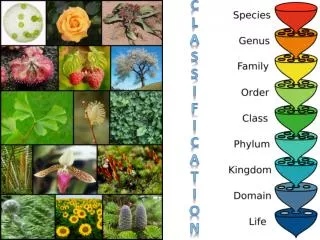
Creepy Critters What did we learn today? • How are organisms are classified? • What factors are most important in classification? • What benefits come from classifying organisms? • What are the major factors that differentiate one species from another? • How would you further classify yourself as an individual, and what traits would be important in that classification? • Where would you begin if you had to classify an unknown plant?
L e s s o n 2 : C l a s s i f i c a t i o n • Read pages 141, 146-156 in the Sciencesaurus book. • Complete the activity sheet to use with reading
1. vertebrates and invertebrates2. backbone or no backbone3. soft bodies, hard shells, exoskeletons4. 5. mammals, birds, reptiles, amphibians, and fish
Examples: shrew, whale, polar bears, human, dolphin, elephant Examples: hummingbirds, chickadees, penguins
Examples: snakes, lizards, turtles Examples: frogs, toads, salamanders
L e s s o n 3 : A n i m a l C l a s s i f i c a t i o n • In a group, sort the Animal Classification cards using characteristics discussed in lessons 1 and 2 (examples: vertebrates/invertebrates, body coverings, diet, etc…) • Using a graphic organizer, show how you sorted the cards.
Discussion Questions • What characteristics did you use to sort • your animals? • Why did you choose those • characteristics to sort your animals?
Step 2 • In a group, come up with a different set of characteristics to sort the animals using the same set of cards. • Using a graphic organizer, show how you sorted the cards.
Follow-up Discussion Questions • What new characteristics did you use to sort your animals? • Why is it important to sort animals into groups? • Why do scientists sort animals into groups? • What are some other things that scientists might classify into groups?
Follow-up Discussion Questions • What is classification? • Why is it important to sort animals into groups? • Why do scientists sort animals into groups?
L e s s o n 4: A d a p t a t i o n A r t i s t r y/ F a s h i o n a F i s h • As we view this powerpoint presentation, pay close attention to the various adaptations of the animals presented. • Look at how these adaptations affect what type of environment these animals live.
Adaptations of Birds A structure or behavior that helps an organism survive in its surroundings.
BEAKS • Pouch-like • Long, thin • Pointed • Curved • Short, stout • Slender, long
Pelican • Pouch-like • Can hold the fish it eats
Avocet • Long, thin beak • Can probe shallow water and mud for the insects it eats
Woodpecker • Pointed Beak • Can break and probe bark of trees for the insects it eats
Hawk • Curved beak • Can tear solid tissue for the meat it eats
Finch • Short, stout beak • Can crack the seeds and nuts it eats
Hummingbird • Slender, long beak • Can probe the flowers for nectar it eats
FEET • Webbed • Long Toes • Clawed • Grasping
Duck • Webbed feet • Aids in walking on mud and swimming
Crane • Long toes • Aids in walking on mud
Heron • Long toes • Aids in walking on mud
Hawk and eagle • Clawed • Can grasp food when hunting prey
Chicken • Grasping feet • Aids in sitting on branches, roosting, protection
LEGS • Flexor tendons • Long, powerful • Long, slender • Powerful muscles
Ostrich • Long, powerful legs • Aids running
Heron and Crane • Long, slender legs • Aids walking
Eagle and Hawk • Powerful muscles • Aids in lifting, carrying prey
WINGS • Large span
Eagle • Large wings • Aids in flying with prey, soaring while hunting
COLORATION • Bright plumage • Dull plumage • Change of plumage for seasons
Owl • Change of plumage with seasons • Provides camouflage protection ( brown in summer, white in winter)
Ptarmigan • Provides camouflage protection • Change of plumage with seasons
Male birds vs. female birds • Male birds – bright plumage aids in attraction in courtship, mating rituals • Female birds – Dull plumage aids in camouflage while nesting
Male or female? Male Female
Male or Female? Male Female
Fashion A Fish Aquatic animals are the result of countless adaptations over time. Adaptations are features that increase the animals likelihood of survival.
Mouth Body Shape Coloration Reproduction Adaptations