The Rise of Industrial Giants: Strategies of Growth and Control in America's Economy
During America's industrial boom, large companies dominated the market, leveraging mergers and innovative management strategies to thrive. The railroad industry exemplified this trend, necessitating substantial investments in factories and labor. John D. Rockefeller's formation of Standard Oil through horizontal integration and Andrew Carnegie's combination of vertical integration set new standards. By merging competing firms, they minimized risks during economic downturns and gained control over pricing and production. Their strategies reshaped the landscape of American industry, demonstrating the power of consolidation and control.

The Rise of Industrial Giants: Strategies of Growth and Control in America's Economy
E N D
Presentation Transcript
When America's industrial growth boomed, only the large businesses could afford the factories, machinery, and labor.
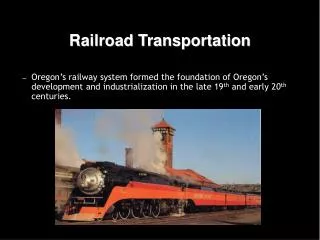
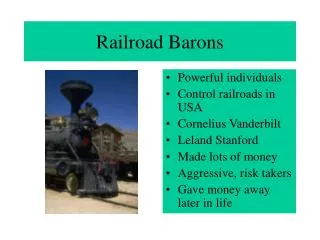
Railroad • The railroad industry was a perfect example • A large enterprise with enormous costs.
This led to new idea in management - departmental mangers responsible for part of the operation.
The best way companies could survive bad economic times, like the depression of the 1870s, was to merge companies - combining several competing firms under a single head.
In the 1860s he started a kerosene business that became Standard Oil in Ohio.
There were hundreds of oil refineries in Ohio and Pennsylvania.
By 1870 his company, Standard Oil, had gobbled up all in Ohio.
Rockefeller could demand rail shipping rates of 10 cents a barrel while the few competitors were asking 35 because he dominate the market.
Horizontal - like Rockefeller: merging all the competing companies in one area of business into one
Vertical - controlling all aspects of production form raw materials to final delivery of the product
bought up coal mines and iron ore deposits for his steel mills, then bough railroads and ships to transport raw materials and ship products to market.