Download

1 / 4
40 likes | 158 Views
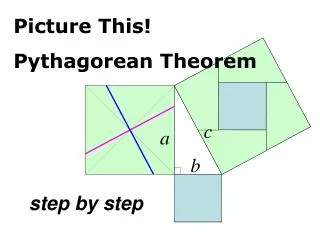
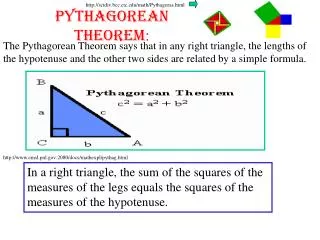
The Pythagorean Theorem is a fundamental principle in geometry for calculating the lengths of sides in a right triangle. To use it effectively, start by writing down the formula (a^2 + b^2 = c^2), where (c) is the hypotenuse. Depending on what you're solving for, substitute the given values into the equation and perform the necessary arithmetic operations. Finally, take the square root of the sum to find the length of the hypotenuse or other side. For example, if (a = 5) and (b = 2), the theorem shows (5^2 + 2^2 = 29), leading you to find (c=sqrt{29}).

E N D
* How To Use The Pythagorean Theorem • First write down the formula • See if your finding the hypotenuse or any other side. • Then you plug in the numbers • After that you solve the problem • First you add or subtract which ever one you have to do. • Then you get the answer and find the square root of it then you have the square root answer.
Problem #1 2 2 2 a + b = c 5 + 2 = c 2 2 2 25 + 4 = 29 Answer is 5.6
Right Triangle Labels Hypotenuse Side B Side A