Understanding Postulates, Proofs, and Theorems in Geometry
This educational resource explains essential concepts in geometry, including postulates, axioms, proofs, theorems, and deductive arguments. It outlines the steps needed to construct a logical proof and provides practical examples to illustrate their application. The document touches on various postulates regarding lines and planes, highlights the reasoning behind geometric statements, and encourages practice through problems that require determining the truth of various statements. This guide is perfect for students seeking to strengthen their understanding of geometric foundations.

Understanding Postulates, Proofs, and Theorems in Geometry
E N D
Presentation Transcript
2-5 Postulates Ms. Andrejko
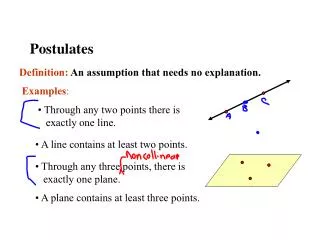
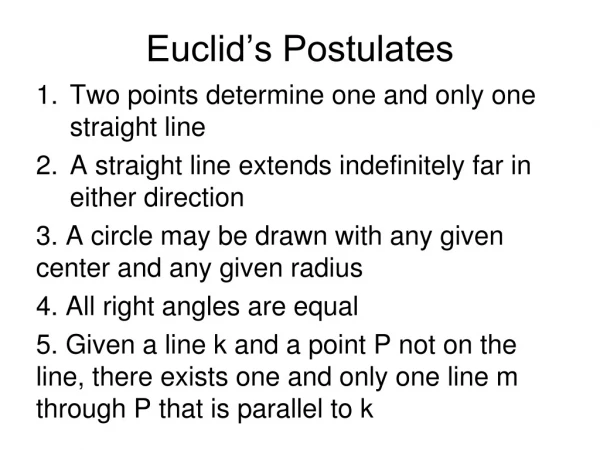
Vocabulary • Postulate/Axiom- is a statement that is accepted as true without proof • Proof- a logical argument in which each statement that you make is supported by a postulate or axiom • Theorem- a statement that has been proven that can be used to reason • Deductive Argument- forming a logical chain of statements linking the given to what you are trying to prove
Steps to a proof • 1. List the given information and if possible, draw a diagram • 2. State the theorem or conjecture to be proven. • 3. Create a deductive argument • 4. Justify each statement with a reason (definition, algebraic properties, postulates, theorems) • 5. State what you have proven (conclusion)
Postulates • 2.1-2.7 • Midpoint theorem
Examples • Explain how the figure illustrates that each statement is true. Then state the postulate that can be used to show each statement is true. • The planes J and K intersect at line m. • The lines l and m intersect at point Q. Postulate: If 2 planes intersect, then their intersection is a line. Postulate: If 2 lines intersect, then their intersection is exactly one point.
Practice • Explain how the figure illustrates that each statement is true. Then state the postulate that can be used to show each statement is true. • Line p lies in plane N. • Planes O and M intersect in line r. Postulate: If 2 points lie in a plane, then the entire line containing those points lies in that plane. Postulate: If 2 planes intersect, then their intersection is a line.
Examples • Determine whether each statement is always, sometimes, or never true. Explain your reasoning. • The intersection of two planes contains at least two points. • If three planes have a point in common, then they have a whole line in common. ALWAYS. The intersection of 2 planes is a line, and we must have at least 2 points in order to create a line. SOMETIMES. 3 planes can intersect at the same line which contains the same point, but they don’t have to.
Practice • Determine whether each statement is always, sometimes, or never true. Explain your reasoning. • Three collinear points determine a plane • Two points A and B determine a line • A plane contains at least three lines NEVER. Postulate tells us that we must have 3 noncollinear points ALWAYS. You can always create a line through any 2 points. SOMETIMES. A plane may contain 3 lines, but it doesn’t have to contain any lines in order to be a plane.
Examples • In the figure, line mand lie in plane A. State the postulate that can be used to show that each statement is true. • Points L, and T and line m lie in the same plane. • Line m and intersect at T. 2.5: If 2 points lie in a plane, then the entire line containing those points lies in that plane 2.6: If 2 lines intersect, then their intersection is exactly one point
Practice • In the figure, and are in plane J and pt. H lies on State the postulate that can be used to show each statement is true. • G and H are collinear. • Points D, H, and P are coplanar. 2.3: A line contains at least 2 points. 2.2: Through any 3 noncollinear points, there is exactly one plane