
Wire Harness – A Detailed Component Guide
Approaching a professional wire harness manufacturer is important in order to ensure that the right components are being installed, considering everything from the environment, temperature, flexibility, and every other aspect.

Wire Harness – A Detailed Component Guide
E N D
Presentation Transcript
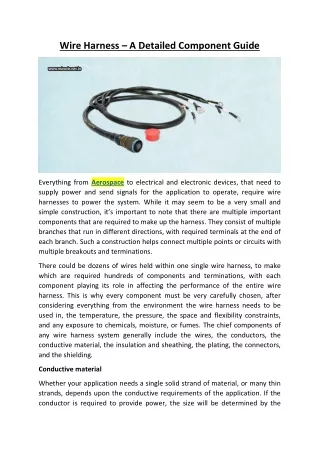
Wire Harness – A Detailed Component Guide Everything from Aerospace to electrical and electronic devices, that need to supply power and send signals for the application to operate, require wire harnesses to power the system. While it may seem to be a very small and simple construction, it’s important to note that there are multiple important components that are required to make up the harness. They consist of multiple branches that run in different directions, with required terminals at the end of each branch. Such a construction helps connect multiple points or circuits with multiple breakouts and terminations. There could be dozens of wires held within one single wire harness, to make which are required hundreds of components and terminations, with each component playing its role in affecting the performance of the entire wire harness. This is why every component must be very carefully chosen, after considering everything from the environment the wire harness needs to be used in, the temperature, the pressure, the space and flexibility constraints, and any exposure to chemicals, moisture, or fumes. The chief components of any wire harness system generally include the wires, the conductors, the conductive material, the insulation and sheathing, the plating, the connectors, and the shielding. Conductive material Whether your application needs a single solid strand of material, or many thin strands, depends upon the conductive requirements of the application. If the conductor is required to provide power, the size will be determined by the
amount of current it needs to carry. Further, where a signal needs to be transmitted, the length and speed will determine the conductor material. Insulation and sheathing The insulation and sheathing of a wire harness may either comprise of thermoset or thermoplastic compositions, depending upon the application. The operating temperature, harshness of the environment, exposure to chemicals or fluids, and the current and voltage requirements, all of these determine the material for insulating the harness. Plating Plating is required when corrosion is a challenge for the application. Plating will provide improved conductivity, along with the required corrosion resistance for the conductors to function in the most challenging environments. Where the wire harness will be required to function amidst moisture, tin can prove to be the best choice, as it has amazing resistance to corrosion. Similarly, for the wire harnesses that need to function under high temperatures, silver or nickel can prove to be an ideal choice as they enable conductors to work reliably up to 200°C and 260°C respectively. Connectors The type and speed of the signal to be transmitted is what decides on the connectors for a wire harness. However, the most basic ones include crimp- type connector, or a soldered or welded connection. The type of connector will also ultimately decide on the choice of the terminal. Shielding Proper shielding can control the electromagnetic interference and any radio frequency interference if present. There are a variety of shields to be selected from, such as foil shields, braided shields, and spiral shields. It is the frequency requirement and the flex life that decide on the shield to be used. The most ideal choice is a combination of foil and braided shielding, which offers the best protection from interference at all frequencies. But, it is also equally expensive. Also to be considered is the fact that the outer sheath material should meet the physical challenges of the harness’s environment, retain its flexibility, and also be flame retardant. PVC seems to be the ideal choice here. Making the right choice for each component is crucial, which is why it is always advisable to approach a professional and experienced wire harness
manufacturer, one like Miracle Electronics, who has immense experience in manufacturing a variety of harnesses like EMI shielded harnesses, multiwire harnesses, flat harnesses, ribbon harnesses, RF harnesses, airborne looms, and military looms (). Hence, no matter what your application, Miracle Electronics always has a solution!
