Download
1 / 11
110 likes | 261 Views
This report discusses the Tulsa Pilot Study and community studies exploring HAZUS's effectiveness in modeling disaster risks like earthquakes, hurricanes, and floods. Key insights include successful strategies and limitations encountered, such as complexities in identifying synergistic activities and uncertainties in risk evaluation tools. The study highlights unexpected mitigation activities and the development of default models for flood losses. Overall, it examines how HAZUS can aid in estimating direct and indirect losses, and emphasizes the importance of refining risk models for better reliability in future evaluations.

E N D
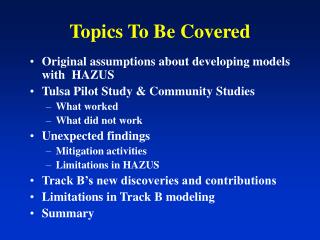
Topics To Be Covered • Original assumptions about developing models with HAZUS • Tulsa Pilot Study & Community Studies • What worked • What did not work • Unexpected findings • Mitigation activities • Limitations in HAZUS • Track B’s new discoveries and contributions • Limitations in Track B modeling • Summary
Assumptions • HAZUS would be capable of modeling the direct and indirect losses associated with earthquake, hurricane and flood risks. • Local data could be combined with NEMIS data and entered into HAZUS to model the costs and benefits of mitigation activities. • Synergistic activities could be identified and evaluated with HAZUS for hurricane vulnerabilities, flooding in riverine basins, and flood vulnerability models.
Tulsa Pilot StudyWhat Worked • Cost data were found in the community. • HAZUS isolated riverine basin model successfully used.
Community StudiesWhat Worked • HAZUS hurricane vulnerability models successfully used in conjunction with national wind velocity probabilistic models. • HAZUS successfully used to estimate earthquake direct losses.
Tulsa & Community StudiesWhat Did Not Work as Planned • Identification of synergistic activities is complex. • Spin-offs • Allied (collateral) activities • The need for indirect loss estimation has been minimal.
Tulsa & Community StudiesWhat Did Not Work as PlannedUnexpected Mitigation Activities • Structural flood mitigations • Tornado risks • Debris flow risks • Chlorine releases • Underground flood risks to wastewater and storm drain systems • Central business district spillover effects. • Other local flood risks that are challenging to model
Track B’s New Discoveries • Developing a coarse default model for flood losses to model numerous sites in three flood basins using flow data embedded in HAZUS. • Attempting to model various structural mitigations (e.g., diversion structures, berms). Serves as a vanguard for Track A evaluations
Track B Limitations that Result from New Discoveries • Maturity of the risk evaluation tools available in HAZUS varies enormously and, as a result, • Reliability of quantitative results will vary depending on the maturity of risk evaluation tools. • Uncertainties for immature risk evaluations are very great. Compare, for example, earthquake direct losses with debris flows and chlorine releases
Track B Limitations that lead to New Discoveries • The fact that Track B has identified mitigation activities that had not been identified by or modeled in HAZUS means that: • Key parameters and their influence on outcomes have had to be evaluated; and • The relative maturity of risk evaluation procedures available in HAZUS can be evaluated.
SummaryTrack B Quantitative Modeling • As planned, Track B is using HAZUS models when they are mature. • Track B has devised methods for evaluating synergistic activities. • In many cases, it has been necessary to develop credible models before analyses can be conducted. • Some of these new models assist in Track A’s more global quantitative evaluation.
SummaryTrack B Quantitative Modeling continued • New models will have varying degrees of reliability. • All models can be subjected to multiple sensitivity evaluations with immature models subjected to more evaluations. • Thus, only major parameters will be considered in sensitivity evaluations. • The credibility of all models will be indicated.