Download
1 / 14
140 likes | 267 Views
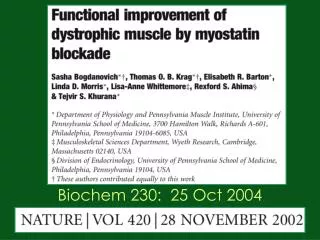
This study explores the role of myostatin and TGF-β signaling in muscle growth inhibition, presenting the effects of JA16 antibodies on cultured cells and in mdx mice, a model for muscular dystrophy (MD). While mdx mice show mild phenotypes and muscle regeneration, the efficacy of anti-myostatin treatment is demonstrated through increased body weight, muscle strength, and overall metabolic enhancement. This research suggests a promising therapeutic avenue for MD and other muscle-wasting conditions, addressing potential applications in aging and inactivity-related muscle loss.

E N D
Some less noble applications … Super TGF
Myostatin and TGFß signaling Inhibition of muscle growth
JA16 antibodies inhibit TGFß pathway in cultured cells 11.5 µL / mL
Switch to in vivo . . . • mdx mice widely used: availability, cost, generation time • but not an ideal phenocopy of MD in humans: - relatively mild phenotype - histologically normal muscle at birth - necrosis begins in week 3, continues for about 1 month - regeneration compensates for muscle damage - mdx muscle does not resemble advanced MD Are myostatin-associated effects dependent on mdx mouse context?
Anti-myostatin associated increases in body weight n=12 P < 0.03 (t-test) 1 month old mice 60 mg/kg antibody weekly for three months
Anti-myostatin associated with metabolic increase and strength Indirect calorimetry - Oxymax Equalflow system Whole body muscle strength, endurance n = 4, p < 0.01 n = 6, p < 0.002 Increased caloric output “consistent with an increase in muscle mass and body size” Increased rota-rod time “consistent with increased functional muscle mass and intact neuromuscular coordination”
Physiological and morphometric comparisons of EDL in treated vs. control mice EDL: extensor digitorum longus CSA: cross-sectional area ECC: eccentric contraction (measures damage and damage recovery) CNF: centrally-nucleated fiber - regeneration or change in progenitor cell commitment
n = 12, p < 0.0001 n = 12, p < 0.014 n = 12, p < 0.03 n = 12, p < 0.003 Anti-myostatin associated increases in muscle mass and strength
Hypertrophy at single fibre level “…overall shift of distribution towards larger areas [of single fibres]”
Decrease in degenerative changes and cellular infiltration in diaphragms of treated mdx mice
Utrophin-independence and biochemical evidence for improvement in treated mdx mice n = 6, p < 0.005 Improvement in treated mdx mice independent of utrophin
Outlook • Improvement ofdystrophic phenotype in mdx mice by anatomical, physiological, and biochemical criteria • Not all dystrophic changes helped: susceptibility to damage by lengthening contractions not improved • Proposed treatment for MD or other causes of muscle loss (aging, infections, immobilization, disease) • Relatively simple compared with gene or cell based therapies • Low toxicity concerns.