Overview of Economic Systems: Traditional, Command, and Market Dynamics
90 likes | 206 Views
This overview explores the three main types of economic systems: Traditional, Command, and Market economies. Each system addresses three fundamental economic questions: what to produce, how to produce, and for whom to produce. It highlights the basic needs for survival, such as food, clothing, shelter, and water, and explains opportunity costs in decision-making. While Traditional economies rely on customs, Command economies are government-controlled, and Market economies emphasize private ownership and supply-demand dynamics, most economies today are mixed, integrating elements of both Command and Market systems.


Overview of Economic Systems: Traditional, Command, and Market Dynamics
E N D
Presentation Transcript
Economic Systems Traditional, Command, Market
Economic Systems Overview…Copy underlined info. . . • Economics- the study of how people, businesses & countries use their limited resources (ie: money & materials) • There are 3 main types of economic systems & they all try to answer 3 BASIC economic questions: • 1. What to produce, 2. How to produce, 3. For whom to produce **How they answer these 3 questions will determine how successful the country is.
Basic NeedsCopy entire slide • We all need 4 basic things to survive: • 1. Food • 2. Clothing • 3. Shelter • 4. Water • Everything beyond these 4 needs is called a WANT (ipod, designer clothes, car)
Opportunity CostCopy underlined info • Opportunity Cost is the thing that is given up when given a choice. • For example---You go to the store you can buy an ipod or bread. You buy the bread. The opportunity cost is the IPOD…..the thing you gave up and did not buy (the opportunity lost). • This is an example of a need VS. a want. The bread is a need (food)—the IPOD is a want.
Gross Domestic Product (GDP): The total amount of goods and services produced in a country in a year
Traditional Economy(Copy entire slide) • Tradition means you do the same thing over and over again… • People produce only what they need to survive and nothing extra • Poor regions of the world have this economy but NO COUNTRY • People inherit their jobs from their parents • Example: if your mom is a doctor you will be a doctor (there is little flexibility) • This is the least developed (poorest) economic type • There is never any change to modernize anything
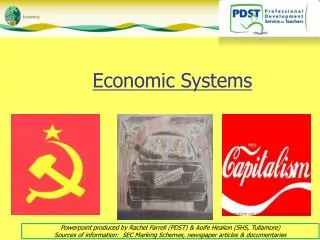
Command Economy (Copy entire slide) • Government owns what is being produced • Business & property belongs to the government instead of private ownership • The government decides what will be produced • The goal is to have economic equality (so there is no rich or no poor, everyone is the same) • A shortage of goods usually exists because the government makes all choices • Better jobs & products do not receive more money= Unfair.
Market Economy(otherwise referred to as Capitalist)Copy entire slide. • Private ownership of business & property • Little government regulation (the government doesn’t determine what to make—instead the markets do—depending on what people need and want) • Freedom to make own choices • Based on supply & demand • Constantly changes to make better products • More $ is offered for better products and workers
Mixed….(Copy entire slide) ***Most Economic System are MIXED (Command Economic system mixed with Market economic system).***