Understanding Dimensional Analysis and Factor-Label Conversions for Measurement
This guide introduces dimensional analysis and factor-label conversions, focusing on quantitative and qualitative measurements. It distinguishes between the English and Metric systems, explains the fundamental SI units, and presents the stair-step method for conversions across different scales. Practice conversion examples (e.g., millimeters to meters) are provided, alongside practical calculations such as determining seconds in a school day and converting height to centimeters. Factor-label hints and an engaging pizza party problem are included to reinforce concepts effectively.

Understanding Dimensional Analysis and Factor-Label Conversions for Measurement
E N D
Presentation Transcript
Basic Measurement • A quantitative measurement always consists of a number and a unit. • A qualitative observation simply makes a statement. • Two major systems are used today: English System – used in US only Metric System (SI SYSTEM)- used by rest of the world
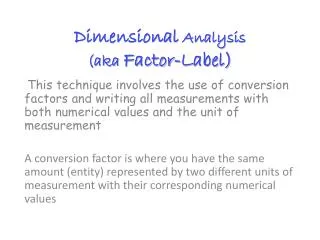
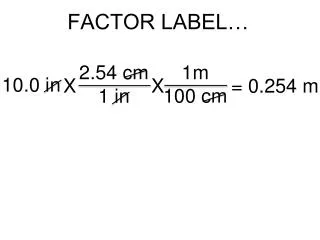
CONVERSIONS • Use equivalent values to move from one measurement to another 1 dozen eggs = 12 eggs ….. 12 eggs = 1 dozen • Using fractions, this can be expressed: 1 dozen OR 12 eggs 12 eggs 1 dozen
Stair Step method Kilo- (K) 1000Hecto- (H) 100Deka- (D) 10 base units Deci- (d) .1Centi- (c) .01Milli- (m) .001 Grams, liters, meters If you know left from right AND If you can count …. YOU CAN CONVERT!
PRACTICE • 525568 mm = ?m • 0.00654 km = ? m 525.568 m Start on mm … Move three …To the Left 6.54 m Start on km… Move three … To the Right
CALCULATE • Calculate how many seconds are in a school day (from 8:00 to 3:00). • Calculate your height in centimeters. (1 inch = 2.54 cm, 12 inches = 1 foot)
FACTOR-LABEL HINTS • START with what is given (amount and unit) • END with what you are trying to get to (unit) • MAKE SURE YOUR UNITS CANCEL ALONG THE WAY! • * Smaller number goes with larger unit. • * Larger number goes with smaller unit. 1 elephant = 40,000 mice USE RAILROAD TRACKS!
FACTOR-LABEL EXAMPLE • You're throwing a pizza party for 15 people. • Each person will eat 4 slices. • Each pizza costs $14.50 and has 12 slices per pizza. • How much is the pizza going to cost you?