Download
1 / 81
820 likes | 951 Views
This guide covers the fundamental principles of naming binary and ternary compounds, including ionic and covalent compounds. It details the rules for naming binary compounds, where the positive element is named first followed by the negative element with an -ide suffix. It explains the use of geometric prefixes in molecular nomenclature, the identification of polyatomic ions, and the naming conventions for acids. Understanding these rules is essential for chemistry students to successfully derive formulas and determine the percent composition of compounds.

E N D
Nomenclature Naming Compounds
KCl NO2 CaCl2 P2O5 Al2O3 H2S Na2O etc
Name positive element first with its normal name • Name negative element last & change its ending to -ide
Name Each: CaCl2 CaS K2O LiF
Name Each: FeCl2 FeCl3
If the Positive element is not from columns I or II • its ox # must be determined and written in roman numerals
Determining the Charge • Add up the oxidation numbers of all the negative elements • The positive portion must balance out the negative portion • Divide the positive portion by the metal subscript
Name Each: CuCl Fe2O3MnO2 CrO3
A covalent compound that can exist as a separate unit • Non-metals bond to form molecules
Same rules as ionic compounds except: • use geometric prefixes to determine the # of each atom
Geometric Prefixes 1-mono 5-penta 2-di 6-hexa 3-tri 7-hepta 4-tetra etc
Name Each: CO S2O3N2H4 SO3
Nomenclature HW • Work problems: • 49 - 54 • on page 51
Drill: Name Each: CaO P2O5Al2S3 SO2
Deriving Formulas • Write the symbol for each element • Determine ox #s for each • Determine lowest common multiple to balance the charge • Apply subscripts
Write formulas for: • Sodium sulfide • Lead (II) iodide • Diphosphorus pentoxide
Write formulas for: • Chromium(III) oxide • Aluminum carbide
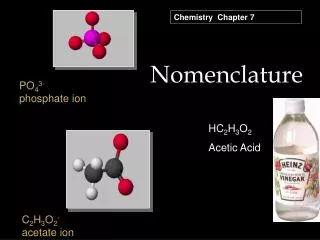
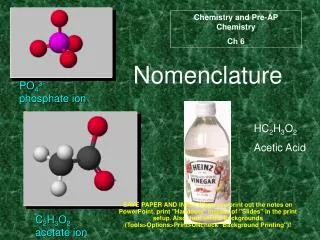
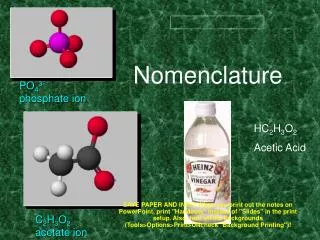
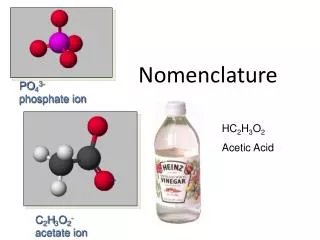
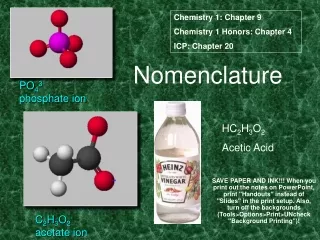
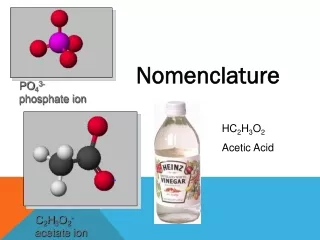
A group of atoms chemically combined that together have a charge
Most are oxoanions • PO4-3 SO4-2 • A root element bound to oxygen
Learn the polyatomic table on page 42 & 43 • Learn how to use the periodic table to determine polyatomic ions
Name the root element • Change the ending to -ate • PO4-3 = phosphate • Some are unusual
CN-1 OH-1 C2H3O2-1C2O4-2
Polyatomic Ion Endings • Maximum O = -ate • 1 less than max O = -ite • SO4-2 = sulfate • SO3-2 = sulfite
Ternary Compounds • Compounds containing more than two different elements • Most contain polyatomic ions
Follow ionic rules for naming the compound • Name the polyatomic ion as the positive or negative portion
Name Each: CaCO3K2SO4
Name Each: Pb(NO3)2MgSO3
Write Formulas For: • Lead (II) nitrate • Aluminum sulfate • Potassium chlorate • Ammonium phosphite
Name the Following: BaSO4 CuNO3 SO2 (NH4)3PO4
Binary acids become: • Hydro _____ ic acids • HCl - Hydrochloric acid
Ternary acids become: • _____ ic acids or • _____ ous acids • H2SO4 - Sulfuric acid • H2SO3 - Sulfurous acid
____ ic acids form from polyatomic ions ending with ___ ate • ____ ous acids form from polyatomic ions ending with ___ ite
___ ide ions become: • hydro ___ ic acids • ___ ate ions become: • ___ ic acids • ___ ite ions become: • ___ ous acids
Determine the atomic mass of each element in the compound • Determine the molecular mass of the compound by adding • Divide each elemental mass by molecular mass • Multiply by 100 %
MgCl2 • Mg = 24.3 g/mole • 2 Cl = 2 x 35.5 = 71.0 g/mole • MgCl2 = total = 95.3 g/mole • % Mg =24.3/95.3 x 100% • % Cl = 71.0/95.3 x 100 %
Determine % Comp for Each: Fe2O3 C3H6O3 CuSO4*5H2O