Download
1 / 29
290 likes | 398 Views
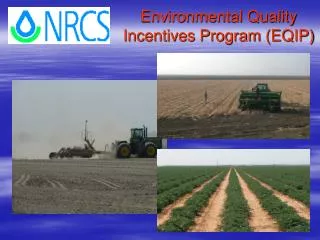
The Environmental Quality Incentives Program (EQIP) is designed to enhance natural resource conservation while promoting sustainable agricultural practices. By integrating environmental quality and agricultural production, EQIP facilitates improved conservation systems through technical and financial assistance. Key features include requiring a conservation plan, an increase in payment limits, and prioritizing water quality and air quality improvements. Producers can apply for funding throughout the year, with an emphasis on innovative conservation strategies. Locally led initiatives guide funding decisions, promoting effective resource management.

E N D
EQIP Key Points • EQIP is a natural resource enhancement program • Addresses natural resource concerns through improved conservation system • Promotes agricultural production and environmental quality as compatible goals
EQIP Key Points • Requires a conservation plan • Provides technical and financial assistance • Considers State Technical Committee and locally led recommendations
EQIP Key Points • FY 2001 & earlier contracts are valid and will be carried to term following the rules that were in effect when the contract was approved
EQIP Key Points • Allows use of EQIP funds in contract’s first year • Increases total payment amounts to $450,000 per individual over the life of the Farm Bill • Reduces contract length • Eliminates “bidding down”
EQIP Key Points • Adds air quality as a purpose • Adds ground and surface water conservation provision
EQIP Key Points • Requires 60 percent of funding for practices related to livestock production, including grazing lands • Eliminates conservation priority areas
EQIP Key Points • Eliminates animal unit cap on large confined livestock operations • Requires Comprehensive Nutrient Management Plan (CNMP) for livestock waste facilities • Allows for an incentive payment to develop a CNMP
How to Apply: • Producers may obtain EQIP applications at any USDA Service Center • Applications will be accepted throughout the year • Applications for EQIP funding will be evaluated periodically
EQIP Conservation Innovation Grants • Initiated after final rule • Competitive grants to stimulate innovation • Grant amount not to exceed 50 percent total project cost • Non-federal government, non-government organizations, and individuals may apply
National Priorities • Reduction of nonpoint source pollutants in impaired watersheds consistent with TMDLs • Reduction of groundwater contamination • Conservation of ground and surface water resources
National Priorities • Reduction of emissions, that contribute to air quality impairment violations of National Air Quality Standards • Reduction in soil erosion and sedimentation from unacceptable levels on ag land • Promotion of at-risk species habitat conservation
Kansas EQIP Natural Resource Concerns • Air Quality • Grazing Lands Health • Soil Erosion • Water Quality • Water Quantity
Air Quality-Wind Erosion • Wind erosion index > 8 • Cost Efficiency/Effectiveness of System Conversion
Air Quality-Livestock Management • Apply Animal Waste Facility and CNMP • Existing/Untreated • Cost Efficiency/Effectiveness of System Conversion
Grazing Lands Health • Planned Grazing System Percent Rest Or Invasive Species Percent Infestation • Cost Efficiency/Effectiveness of System Conversion
Water Quality – Confined Animal Waste • Apply Animal Waste Facility and CNMP • Existing/Untreated, Existing/Improved Efficiency, New or Expanding • High Priority TMDL (Fecal Coliform) Or KGS Sensitive Ground Water Area • Cost Efficiency/Effectiveness of System Conversion
Water Quality – Concentrated/Non-Confined • Apply Animal Waste Facility and CNMP • Proximity of Existing Feeding Site to Water Body • High Priority TMDL (Fecal Coliform) Or KGS Sensitive Ground Water Area • Cost Efficiency/Effectiveness of System Conversion
Water Quality – Nutr./Pest/Sed. • KGS Sensitive Ground Water Area Or High Priority TMDL (Eutr., Dis. Ox., Nutr., Pest.) • Proximity To Receiving Water Body • Nitrate Leaching Potential Or Potential Soil Loss Index • Cost Efficiency/Effectiveness of System Conversion
Water Quantity – Water Management • Conversion To Non-Irrigated • Increased Efficiency – Crop Rotation • Increased Efficiency – Irrigation System Conversion • Cost Efficiency/Effectiveness of System Conversion
EQIP Eligible Practices • FOTG Standards • Interim Standards
More Information…. • Local NRCS Office, USDA Service Center • Local Conservation District • World Wide Web at: http://www.nrcs.usda.gov/programs/farmbill/2002/
The Natural Resources Conservation Service provides leadership in a partnership effortto help people conserve, maintain, and improve our natural resources and environment.