Download

1 / 11
110 likes | 211 Views
The Hundred Years' War (1337-1453) marked a pivotal struggle between English and French monarchs over succession and territorial claims. The conflict arose after the death of Charles IV of France, leading to Edward III of England asserting his claim to the French crown. Although France initially had the upper hand with larger armies, England's tactical innovations, particularly the use of the longbow, offered significant advantages. Figures like Joan of Arc emerged to unite the French and inspire a newfound sense of national identity, ultimately contributing to the tides of war turning in favor of France.

E N D
The Hundred Years War English Kings & French Land
Controversy Over Succession • In 1328, the Capetian dynasty in France came to an end with the death of Charles IV. • The French nobility selected Philip of Valois, a cousin of the last king. • He was chosen in preference to King Edward III of England, whose mother was the daughter of the late king. • In 1340, Edward claimed the title “King of France.”
French National Identity • Edward was actually Philip’s vassal, holding French territories as fiefs from the king of France [going back to the Norman conquest]. • France was not a united country before the war began. • The French king only controlled about half of the country.
The Hundred Years War French Advantages English Advantages England’s most successful strategies: Avoid pitched battles. Engage in quick, profitable raids Steal what you can. Destroy everything else. Capture enemy knights to hold for ransom. New Weaponry • Population of about 16,000,000. • Far richer and more populous than England. • At one point, the French fielded an army of over 50,000. At most, Britain mustered only 32,000.
The English Longbow • The use of the longbow by the English gave them a better defensive position. • Its arrows had more penetrating power than a bolt from a crossbow. • Could pierce an inch of wood or the armor of a knight at 200 yards! • A longbow could be fired more rapidly than a crossbow. • 6 arrows per minute.
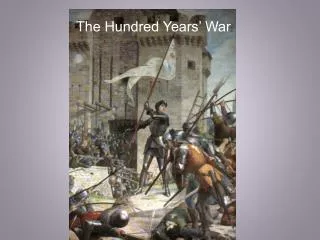
The French “Reconquest” • Even though in 1428 the military & political power seemed firmly in British hands, the French reversed the situation. • In 1429, with the aid of a mysterious peasant girl, the French king, Charles VII, was able to break the English siege of Orleans. • This began the reconquest of the north of France.
Joan of Arc (1412-1432) • The daughter of peasants from Burgundy, an area that had suffered under the English. • Like many medieval mystics, she reported regular visions of divine revelation. • Her “voices” told her to go to the king and assist him in driving out the English. • She won over the king & became Charles’ most charismatic & feared military leader.
Heretic • With her aid, the king was crowned at Reims. • She was captured during an attack on Paris and fell into English hands. • Because of her “unnatural dress” and claim to divine guidance, she was condemned and burned as a heretic in 1432. • She brought inspiration, self-confidence, and a sense of national identity to the French.