Variables and Constants
Variables and Constants. Variables. Variables represent names of memory locations during program execution. Data values processed in the program are stored in memory locations and referenced through variables. Rules of Naming Variables.

Variables and Constants
E N D
Presentation Transcript
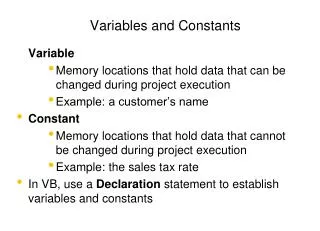
Variables • Variables represent names of memory locations during program execution. • Data values processed in the program are stored in memory locations and referenced through variables.
Rules of Naming Variables • A variable name is a sequence of characters each of which is chosen from the following: letters a b...z A B…Z digits 0 1…9 underscore _ • A variable name must start with either a letter or an underscore. • A variable cannot be a reserved word such as int, float double, if, switch … • The length of a variable name is not limited, although some compilers limit it to 32 characters • C/C++ is case sensitive: sum≠SUM≠Sum≠sUM
Examples of ValidVariable Names X Abc Sum Sum_5 Sum_of_values _x10 X245 a29bc56H INT Float
Examples of InvalidVariable Names if 4x1 Value? double x>y 19 a-b A* Student score
Declaring Variables • Any variable must be declared (defined) before it can be used in the program. • The same variable cannot be defined more than once within the same block • The general form of a variable declaration: data_type variable_name ; • Variables of the same type can be defined in one declaration: data_type var_name1 , var_name2 , … , var_namen;
Examples of Declaring Variables int W; // allocates 2 bytes for w int j=2; int A, B, C; int D, E=8, F, G=-600; float x, y=9.7; char z=‘L’; double L; long r, s=786543, t;
Example: A programContaining Invalid Declarations #include <iostream.h> void main(){ int x 1; double a; char a; char C=“C”; Float y; long c;d; }
Constants • A constant is a named value • Example #define SIZE 100 #define PIE 3.14 • A constant cannot be reassigned a value. The following are invalid: SIZE=200; PIE=PIE+2.5; • The compiler replaces all occurrences of a constant by its value
Example #define A 10000 void main(){ int X=A; int Y=A; int X[A]; for(int k=1; k<=A; k++) cout<<k; } Is equivalent to void main(){ int X=10000; int Y=10000; int X[10000]; for(int k=1; k<=10000; k++) cout<<k; }