Complications in Patients Undergoing RRT: A Review of Randomized Trial Data
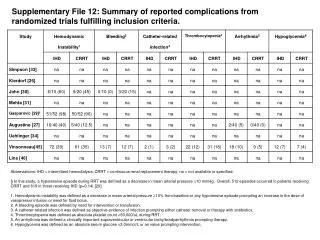
This report summarizes the complications observed in patients undergoing renal replacement therapy (RRT), focusing on intermittent hemodialysis (IHD) and continuous renal replacement therapy (CRRT). It highlights key definitions, including hypotensive episodes, hemodynamic instability, bleeding, catheter-related infections, thrombocytopenia, arrhythmias, and hypoglycemia. A total of 512 hypotensive episodes were recorded during CRRT, compared to 619 during IHD (p=0.14). The findings provide crucial insights into complications that impact patient management and outcomes during RRT.

Complications in Patients Undergoing RRT: A Review of Randomized Trial Data
E N D
Presentation Transcript
Supplementary File 12: Summary of reported complications from randomized trials fulfilling inclusion criteria. Abbreviations: IHD = intermittent hemodialysis; CRRT = continuous renal replacement therapy; na = not available or specified. § In this study, a hypotensive episode during RRT was defined as a decrease in mean arterial pressure 10 mmHg. Overall, 512 episodes occurred in patients receiving CRRT and 619 in those receiving IHD (p=0.14).[29] 1. Hemodynamic instability was defined as a decrease in mean arterial pressure 10% from baseline or any hypotensive episode prompting an increase in the dose of vasopressor infusion or need for fluid bolus. 2. A bleeding episode was defined by need for intervention or transfusion. 3. A catheter-related infection was defined as objective evidence of infection prompting either catheter removal or therapy with antibiotics. 4. Thrombocytopenia was defined as absolute platelet count <50,000/uL during RRT. 5. An arrhythmia was defined a clinically important supraventricular or ventricular tachy/bradyarrhythmia prompting therapy. 6. Hypoglycemia was defined as an absolute serum glucose <3.0mmol/L or an value prompting intervention.