Download
1 / 1
10 likes | 121 Views
An international team from Cornell University has made a groundbreaking discovery, creating the world's thinnest pane of glass, only two atoms thick, entering the Guinness Book of World Records. By utilizing electron microscopy, researchers have observed how individual atoms in this ultra-thin glass bend, deform, and melt. This research has unveiled basic atomic "dance moves" that allow the material to deform before breaking. The findings pave the way for enhanced understanding of glass properties, promising applications in computer chips and quick-charging batteries.

E N D
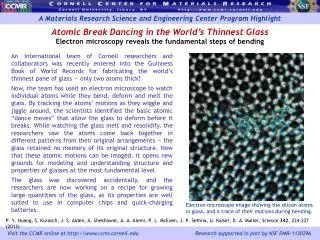
Atomic Break Dancing in the World’s Thinnest Glass Electron microscopy reveals the fundamental steps of bending An international team of Cornell researchers and collaborators was recently entered into the Guinness Book of World Records for fabricating the world’s thinnest pane of glass — only two atoms thick! Now, the team has used an electron microscope to watch individual atoms while they bend, deform and melt the glass. By tracking the atoms’ motions as they wiggle and jiggle around, the scientists identified the basic atomic “dance moves” that allow the glass to deform before it breaks. While watching the glass melt and resolidify, the researchers saw the atoms come back together in different patterns from their original arrangements — the glass retained no memory of its original structure. Now that these atomic motions can be imaged, it opens new grounds for modeling and understanding structure and properties of glasses at the most fundamental level. The glass was discovered accidentally, and the researchers are now working on a recipe for growing large quantities of the glass, as its properties are well suited to use in computer chips and quick-charging batteries. Electron microscope image showing the silicon atoms in glass, and a trace of their motions during bending. P. Y. Huang, S. Kurasch, J. S. Alden, A. Shekhawat, A. A. Alemi, P. L. McEuen, J. P. Sethna, U. Kaiser, D. A. Muller, Science342, 224-227 (2013) Visit the CCMR online at http://www.ccmr.cornell.edu Research supported in part by NSF DMR-1120296