Understanding Earth’s Biosphere and Organism Classification
This chapter explores the biosphere, the region of Earth that supports life, and the classification system of living organisms. With over two million known species, the chapter examines different environments such as deserts, oceans, and rainforests. It explains how all organisms are interconnected, share cellular structures, and possess unique adaptations for survival. The classification of organisms, pioneered by Carolus Linnaeus, categorizes them into kingdoms, phyla, classes, orders, families, genera, and species. Additionally, it addresses the diversity among bacteria, fungi, and protists.

Understanding Earth’s Biosphere and Organism Classification
E N D
Presentation Transcript
Chapter 1 Classification Section 1 and Section 2
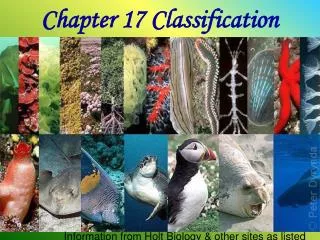
Where on Earth do Organisms Live • I. Biosphere- the part of the Earth that can support living things • All organisms (2 million + 10,000 new ones a year) • Environments- desert, oceans, fields, rainforest • A. All organisms in biosphere are connected • All are made of cells ( can be one cell or more) • Have different characteristics (snail vs. horse)
Adaption- • A. All organisms in the biosphere are connected • Adaptation- a characteristics that enables to an organism to survive and reproduce • Examples- Spines on cactus are modified leaves • Helps stop water loss • Protect from harsh temperatures • Thick stems store a lot of water
Species • B. Species- a group of similar organisms whose members can reproduce and produce offspring that can reproduce. • Animals that look alike are not necessarily in the same species. • Example- Horses and donkeys can mate to produce a mule, but mule’s can’t reproduce
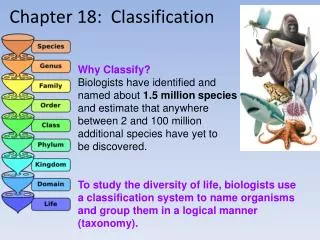
Lesson 2: How do we group organisms • 1. Classification- a grouping of organisms based on similarities • Carolus Linnaeus is considered the Father of Classification- 1700’s • Grouped into two main groups- plant or animal kingdom • Each kingdom was divided into 6 smaller groups based on their features
6 levels in a kingdom • Kingdom • Phylum • Class • Order • Family • Genus • Species • King Philip Came Over For Great Spaghetti • More variety Less Variety
Bacteria • II. Bacteria- not discovered until after Linnaeus created his two major kingdoms • Single Cell organisms • No Nucleus
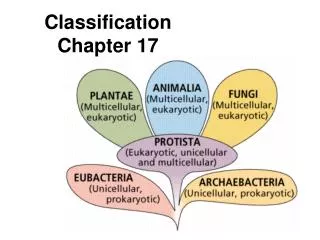
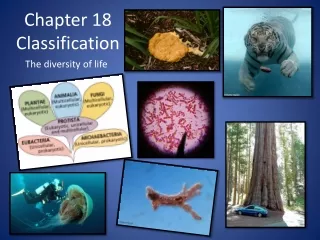
Kingdoms today • III. Today we have 6 kingdoms • A. Animals- get energy from eating other organisms • B. Plants- • Use Photosynthesis to make glucose( a sugar) from • Sunlight, carbon dioxide, and water • If we did not have plants then life on Earth would cease to exist
Fungi • C. Fungi • Used to make food- cheese or medicine- pencillin • Harmful- ringworm, athlete’s foot, and plant rusts • No chlorophyll so can’t make food • Absorb food and nutrients through a membrane • Grow in damp, dark areas
Protists • D. Protists • 3 types • Animal like- get energy from eating other animals • Plant like- contain chlorophyll so can make own food • Fungus like- absorb food through membrane
Eubacteria • E. Eubacteria • Are everywhere • More bacteria in mouth than people in the world • Used to make yogurt • Make vitamins in your body • Make soil fertile
Archaebacteria • E. Archaebacteria • Live in extreme conditions such as high salt areas or very hot water • Benn on Earth for billions of years