Trading Latency for Composability
This paper by Slobodan Matic explores trading latency for composability in real-time systems, focusing on the Simulink and Giotto semantics. It contrasts fast and slow connections in real-time workflows, demonstrating how Giotto's LET model can optimize every connection’s performance. The research emphasizes independent task group abstraction, hierarchical scheduling, and guarantees of task precedences, aiming to achieve significant reductions in latency for tasks that require composability. Important findings include tighter abstractions leading to better integration and compositional modularity in distributed systems.

Trading Latency for Composability
E N D
Presentation Transcript
Trading Latency for Composability Slobodan Matic UC Berkeley
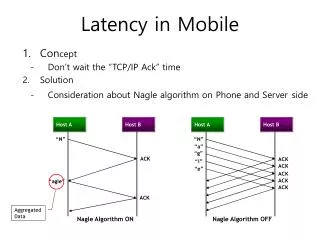
Simulink vs Giotto Semantics • RTW (Simulink) fast to slow connection • LET (Giotto) every connection • Sequence of n tasks RTW latency up to n times smaller "Trading Latency for Composability", S. Matic
Composable Real-time Systems • Real-time assurance + Flexibility • hierarchical scheduling frameworks • Independent task group abstraction • periodic resource model (P,C) • guarantees C units in every P units • Task precedence graphs • intragroup, intergroup, distributed precedence "Trading Latency for Composability", S. Matic
Intragroup Abstraction • Task precedence within group, single resource • Function cS tightly abstracts G if cS(P) is smallest C s.t. G is schedulable with S under (P,C) • smaller cS! tighter abstraction ! better composability • For each G and P cRTW(P) ¸ cLET(P) cRTW cS cLET P "Trading Latency for Composability", S. Matic
Distributed / Intergroup Abstraction • Distributed task graph over m resources • There exist G and P cRTW(P) – cLET(P) ¸ (m-1)P • Task precedence between groups • hierarchical task graph • LET compositional (cj ! c) • RTW not compositional "Trading Latency for Composability", S. Matic