Download

1 / 9
0 likes | 1 Views
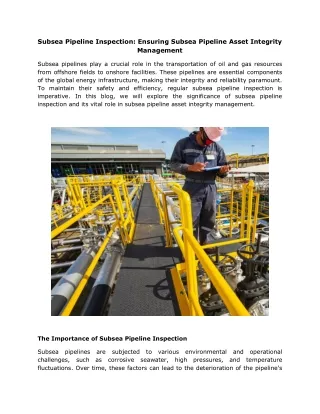
Autonomous and semi-autonomous ROVs (and AUVs) for subsea pipeline inspection are an evolving segment within the broader remotely operated vehicles market, which is projected to grow at around 8u201310% CAGR through the early 2030s, with market value roughly doubling from the mid-2020s. Price trends have been shaped by both technology maturation and demand cycles. Traditional work-class ROV systems remain high-ticket items, but competition and incremental design improvements have gradually reduced cost per capability. For autonomous inspection vehicles,

E N D
Price Trends and Production Data Report Forecast Report Autonomous ROVs for Pipeline Inspection Production, Price Report 01
Autonomous ROVs for Pipeline Inspection Production and Price Overview Historical Growth Rates and Past Performance Autonomous ROVs for Pipeline Inspection production grew steadily between 2018 and 2024, rising from around 2,300 units to nearly 3,900 units as offshore operators increased spending on inspection automation. The market expanded at an average annual rate of 7–8%, supported by new pipeline builds and the shift away from crewed inspections. In 2025, global output is projected to exceed 4,200 units as Autonomous ROVs for Pipeline Inspection production continues to scale, with manufacturers adding capacity in North America and Europe. The Autonomous ROVs for Pipeline Inspection price in 2025 stands at about $185,000/MT, driven by higher sensor integration costs. This Autonomous ROVs for Pipeline Inspection price reflects advanced battery modules, AI-navigation packages, and upgraded thrusters. 02 Request a sample at - https://datavagyanik.com/reports/global-autonomous-rovs-for-pipeline-inspection-market/
Key Indicators Impacting Autonomous ROVs for Pipeline Inspection Prices in 2025 The Autonomous ROVs for Pipeline Inspection price in 2025 is heavily influenced by the cost of high-performance sensors, which account for nearly one-third of total build value. The expanded use of multibeam sonar and laser-based mapping has raised calibration and Autonomous ROVs for Pipeline Inspection price elevated. Battery modules, especially long-endurance lithium units, also contributed to a 6–7% cost increase year-on-year. assembly expenses, keeping the Supply tightness in underwater propulsion components further pushed the Autonomous ROVs for Pipeline Inspection price upward as manufacturers competed for precision motors. Labor costs rose in 2024–25 due to the need for specialized robotics technicians, adding pressure on the final Autonomous ROVs for Pipeline Inspection price. Meanwhile, logistics and export-certification fees for offshore markets increased due to stricter inspection standards in Asia and the Middle East. Despite these pressures, some price stabilization emerged from bulk procurement of electronics and improved modular assembly. However, overall pricing in 2025 remains slightly higher than the previous year as technological sophistication continues to shape the cost base. 03
MARKET SEGMENTATION The market for Autonomous ROVs for Pipeline Inspection can be segmented by capability, depth rating, application, propulsion type, and end-use industry. By capability, the market includes standard inspection ROVs equipped with cameras and sonar, and advanced autonomous units featuring AI-driven navigation, automatic route planning, and real-time anomaly detection. Demand is rising fastest in the advanced category as operators prioritize predictive maintenance. By depth rating, the market covers shallow-water units (<300 m), mid-depth models (300–1,000 m), and deepwater ROVs exceeding 1,000 m ratings. Deepwater models generate the highest revenue due to higher component complexity and certification requirements. By application, segments include pipeline integrity inspection, leak detection, corrosion mapping, burial assessment, and emergency response. Pipeline integrity inspection remains dominant, but leak detection units are growing quickly as environmental regulations tighten. By propulsion type, the market covers electric, hybrid, and battery-only ROVs. Battery-only models are expanding their share due to longer endurance and lower maintenance. By end-use industry, offshore oil and gas accounts for the majority of demand, followed by subsea construction, offshore wind, and government marine monitoring agencies. Overall, segmentation shows a clear shift toward intelligent, high-end models with integrated autonomy and enhanced endurance profiles. 04
COMPETITIVE LANDSCAPE Database of 50+ Key Manufacturers • Saab Seaeye • Oceaneering International • Bluefin Robotics • Fugro • ECA Group • Kawasaki Robotics • Schilling Robotics • TechnipFMC • Forum Energy Technologies 05
Economic Indicators & External Factors Macroeconomic conditions in 2025 indicate stable offshore capital expenditure, supporting Autonomous ROV deployment. Moderate inflation and steady industrial metals prices have allowed equipment makers to plan production without severe cost shocks. Exchange rate swings, especially between USD and EUR, affected component procurement but remained manageable. Offshore project approvals in the Middle East and Brazil increased inspection activity, while geopolitical tensions slightly slowed European operations. 06
FUTURE MARKET FORECASTS 07
STRATEGIC ROADMAP Key Competitors Scaling Businesses Entering New Markets Launching New Products 08
THANK YOU • https://datavagyanik.com/ • SALES@DATAVAGYANIK.COM • +1-330-440-0311 Request a sample at - https://datavagyanik.com/reports/global-autonomous-rovs-for-pipeline-inspection-market/ 9