Existence of (0,1)-Matrices Given Row and Column Sums
This document explores the existence of (0,1)-matrices with specified row and column sums. We define the row-sum vector r based on given row sums r1, r2, …, rk, and similarly for column sums. The concept of majorization between two partitions is introduced, highlighting that r majorizes s when their sums equal for all k. We present Theorem 1, which states that if r and s are two nonincreasing sequences summing to the same value N, then there exists an n x m (0,1)-matrix with row sums r and column sums s if r* majorizes s.

Existence of (0,1)-Matrices Given Row and Column Sums
E N D
Presentation Transcript
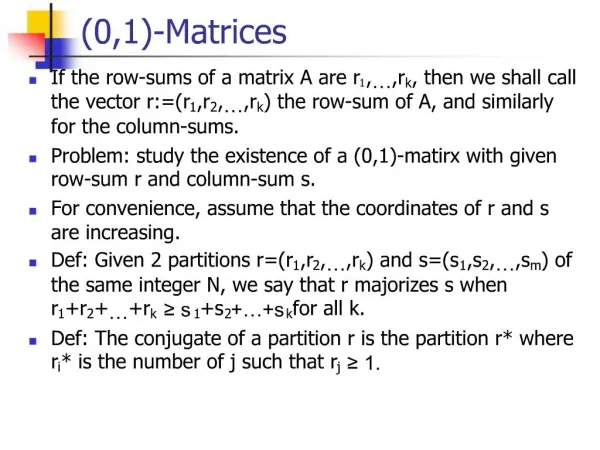
1. (0,1)-Matrices If the row-sums of a matrix A are r1,…,rk, then we shall call the vector r:=(r1,r2,…,rk) the row-sum of A, and similarly for the column-sums.
Problem: study the existence of a (0,1)-matirx with given row-sum r and column-sum s.
For convenience, assume that the coordinates of r and s are increasing.
Def: Given 2 partitions r=(r1,r2,…,rk) and s=(s1,s2,…,sm) of the same integer N, we say that r majorizes s when r1+r2+…+rk = s1+s2+…+sk for all k.
Def: The conjugate of a partition r is the partition r* where ri* is the number of j such that rj = 1.
2. Thm 1. Let r1,…,rn and s1,…,sm be 2 nonincreasing sequences of nonnegative integers each summing to a common value N. There exists an nxm (0,1)-matrix with row-sum r and column-sums iff r* majorize s. Pf: “?” Suppose such a matrix exists with row-sum r and column-sum s. Consider the first k columns. The number of 1’s in these columns is Thus, we have r* majorizes s.
![[MATRICES ]](https://cdn4.slideserve.com/144276/matrices-dt.jpg)