Download
1 / 7
70 likes | 181 Views
This lecture explores key concepts in stoichiometry, including balancing chemical equations, calculating molar masses, and determining the number of moles of reactants and products. You will learn to apply balanced equations to compute product masses based on moles and molar mass. Additionally, we delve into the structure of the Periodic Table, identifying periods and groups, and highlighting the historical developments that shaped its creation, from Dobereiner's Triads to Mendeleev's contributions. By the end, you will appreciate the importance of these topics in chemistry.

E N D
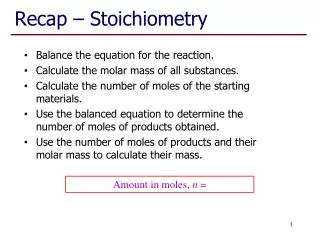
Recap – Stoichiometry Balance the equation for the reaction. Calculate the molar mass of all substances. Calculate the number of moles of the starting materials. Use the balanced equation to determine the number of moles of products obtained. Use the number of moles of products and their molar mass to calculate their mass. Amount in moles, n =
The Periodic Table • Periods – rows – properties change across a period • Groups – columns – similar properties are found amongst the members of a group
The Periodic Table - Historical • 1817 Dobereiner’s “Triads”
The Periodic Table - Historical • 1865 Newlands’ “Law of octaves”
The Periodic Table - Historical • 1869 Dmitri Mendeleev Review: http://www.youtube.com/watch?v=M-lnauoORdA
Learning Outcomes: By the end of this lecture, you should: appreciate the historical context of the Periodic Table