Electron Configurations
This overview delves into the quantum mechanical model of the atom, explaining electron configurations, energy levels, and orbitals. It highlights the probabilistic nature of electron positioning, introducing quantum numbers that define electrons like an address. Key conceptos, such as the Pauli Exclusion Principle and Hund's Rule, govern electron arrangements, while orbital diagrams provide a visual representation of electron spin and configuration. Additionally, quotes from notable physicists illustrate the complexities and nuances of quantum theory, encouraging deeper understanding of atomic structures.

Electron Configurations
E N D
Presentation Transcript
Electron Configurations “Any one who is not shocked by Quantum theory does not understand it.” Niels Bohr
Electron Configurations • The quantum mechanical model of the atom predicts energy levels for electrons; it is concerned with probability, or likelihood, of finding electrons in a certain position.
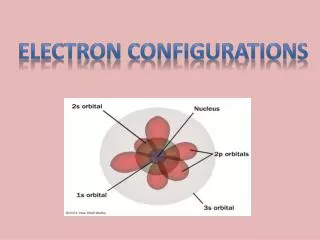
Electron Configurations • Regions where electrons are likely to be found are called orbitals. EACH ORBITAL CAN HOLD UP TO 2 ELECTRONS!
Electron Configurations • In quantum theory, each electron is assigned a set of quantum numbers • analogy: like the mailing address of an electron
Playing Chopin with Boxing Gloves • “Trying to capture the physicists’ precise mathematical description of the quantum world with our crude words and mental images is like playing Chopin with a boxing glove on one hand and a catcher’s mitt on the other.” (1996). Johnson, George. On skinning Schrodinger’s Cat. New York Times.
Erwin Schrödinger I don’t like it, and I’m sorry I ever had anything to do with it.
Principal Quantum Number (n) • Describes the energy level that the electron occupies • n=1, 2, 3, 4 • The larger the value of n, the farther away from the nucleus and the higher the energy of the electron. n = 1 n = 2 n = 3 n = 4
Sublevels (l) • The number of sublevels in each energy level is equal to the quantum number, n, for that energy level. • Sublevels are labeled with a number that is the principal quantum #, and a letter: s, p, d, f (ex: 2 p is the p sublevel in the 2nd energy level)
Sublevels (l) n = 1 1s one (1s) 2s 2p one (2s) three (2p) n = 2 one (3s) three (3p) five (3d) n = 3 3s 3p 3d n = 4 4s 4p 4d 4f one (4s) three (4p) five (4d) seven (4f)
Sublevels (l) s 2 1 p 3 6 10 d 5 f 7 14
Electron Configurations Start Filling Here
Complete electron configurations 1s2 • helium • boron • neon • aluminum • uranium 1s22s22p1 1s22s22p6 1s22s22p63s23p1 1s22s22p63s23p64s23d104p65s24d10- 5p66s24f145d106p67s25f4
helium boron aluminum cobalt uranium N3- Se2- Mg2+ Abbreviated electron diagrams 1s2 [He]2s22p1 [He]2s22p6 = [Ne] [Ne]3s23p1 [Kr] [Ar]4s23d7 [Rn]7s25f4 [Ne]
Spin quantum number (ms) • Labels the orientation of the electron • Electrons in an orbital spin in opposite directions; these directions are designated as +1/2 and -1/2 (or arrows pointing in opposite directions)
Pauli Exclusion Principle • States that no 2 electrons have an identical set of four quantum #’s to ensure that no more than 2 electrons can be found within a particular orbital.
Hund’s Rule • Orbitals of equal energy are each occupied by one electron before any pairing occurs. • Repulsion between electrons in a single orbital is minimized • All electrons in singly occupied orbital must have the same spin. • When 2 electrons occupy an orbital they have opposite spins.
Orbital Diagrams • Each orbital is represented by a box. • Each electron is represented by an arrow.
Orbital Diagrams • hydrogen • helium • carbon 1s 1s 1s 2s 2p