Download
1 / 1
10 likes | 105 Views
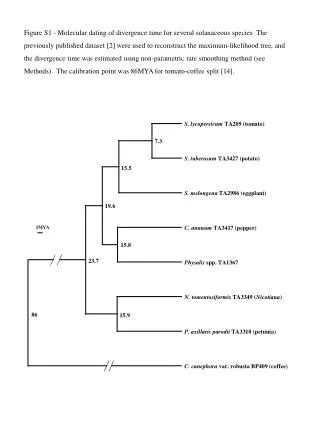
This study uses a non-parametric rate smoothing method to estimate divergence times for solanaceous species such as tomato, potato, eggplant, and pepper. The calibration point is set at 86 MYA for the tomato-coffee split. The maximum-likelihood tree is reconstructed using a previously published dataset.

E N D
Figure S1 - Molecular dating of divergence time for several solanaceous species The previously published dataset [2] were used to reconstruct the maximum-likelihood tree, and the divergence time was estimated using non-parametric rate smoothing method (see Methods). The calibration point was 86MYA for tomato-coffee split [14]. S. lycopersicum TA209 (tomato) 7.3 S. tuberosum TA3427 (potato) 15.5 S. melongena TA2986 (eggplant) 19.6 C. annuum TA3417 (pepper) 1MYA 15.8 23.7 Physalis spp. TA1367 N. tomentosiformis TA3349 (Nicotiana) 86 15.9 P. axillarisparodii TA3310 (petunia) C. canephora var. robusta BP409 (coffee)