Download
1 / 4
40 likes | 164 Views
Eyelid Motion Monitor (EMM). A. Hanuka 1 , B. Blankrot 1 , S. Eizner 1 , L. Karabchevsky 1 , W. Hilo 2 , D. Perez 1 , E . Shoshan 1 , D . Briscoe 2 , L . Schächter 1 1 Department of Electric Engineering, Technion-IIT, Haifa 32000, Israel

E N D
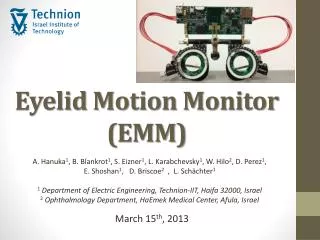
Eyelid Motion Monitor (EMM) A. Hanuka1, B. Blankrot1, S. Eizner1, L. Karabchevsky1, W. Hilo2, D. Perez1, E. Shoshan1, D. Briscoe2 , L. Schächter1 1Department of Electric Engineering, Technion-IIT, Haifa 32000, Israel 2Ophthalmology Department, HaEmek Medical Center, Afula, Israel March 15th, 2013
Background • Opening the eyelid: Levator muscle - Controlled by Occulomotor nerve Muller muscle - Controlled by the sympathetic system. • Closing the eyelid: Orbicularis muscle is responsible for closing - controlled by the facial nerve (cranial nerve VII) • The functionality of the eyelid is affected by: Damage to one of these muscles or nerves Eye disease (Ptosis, Cataract, Glaucoma) Systemic diseases and physiological changes Degenerative neurologic diseases – management for progressing Topical and systemic medications
Conceptual operation Doctor Patient USB cable PC Application Results of analysis Eyelid Movement Sensor
Device Performance 1 • Portable system • Samples each eye separately • Evoked motion • Output: position, velocity , frequency • Two operating modes: • Real time - data stored on the computer • Offline - data stored on the device’s memory • User friendly interface • Data analysis and presentation • Multiple tests for a single patient • Simultaneous multiple device support 2 4 3