Download
1 / 7
70 likes | 224 Views
This guide explores the fundamentals of pedigrees, akin to family trees, which illustrate how traits and diseases are inherited through generations. It covers key aspects such as the transmission of traits, probability predictions for affected offspring, and identifying whether traits are dominant or recessive, as well as determining if the gene is autosomal or X-linked. Examples and practice problems offer a hands-on approach to understanding gene inheritance and pedigree analysis, equipping learners with practical skills in genetics.

E N D
Understanding PEDIGREEs
PEDIGREEs • They are like family trees • They show: 1) How traits are transmitted (causes of diseases) • 2) Predictions of the probabilities of having an affected child • 3) If the trait is dominant or recessive • 4) If the gene is autosome or X-linked
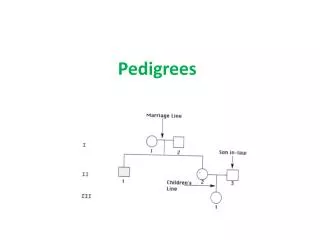
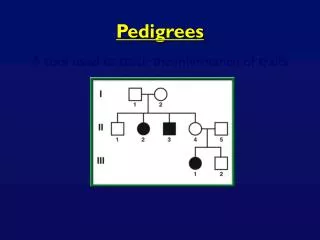
PEDIGREE EXAMPLE NOTE: The generations are given Roman Numerals which are listed on the left hand side of the pedigree. Tt Tt i 2. 2. 3. 3. iI 2. 1. 2. tt T- T- 1. The coloured female has to be “tt”. 2. All the ones that are not coloured have to have a “T”. 3. If one of the offspring is “tt” then it got one “t” from the mother and one “t” from the father. 4. The genes for the other offspring cannot be figured out so you put a dash.
PEDIGREE PRACTISE PROBLEM The ability to roll your tongue is determined by the dominant gene (T). In the following pedigree, affected individuals CAN roll their tongue. Based on the pedigree, determine the genotype for each individual. i Ii IIi
1 2 3 4 i Tt tt tt T 9 10 6 7 8 5 Ii tt tt Tt Tt Tt tt 12 13 14 17 15 16 11 IIi T T Tt Tt tt tt tt All the non-filled in males and females have to be “tt”. All the filled in males and females have to have a “T”. Number 1 must be “Tt” because it has an offspring that is “tt”. Number 7 must be “Tt” because it got the “T” from the father so it can only get “t” from its mother. Number 8 must be “Tt” because it got the “T” from the mother and so it can only get “t” from its father. Number 9 must be “Tt” because it got the “T” from the mother and so it can only get “t” from its father. Number 16 and 17 must be “T” because they got the “T” from their father so they can only get “t” from their mother. Number 4, 14, and 15 remain unknown. tt T Tt