Download
1 / 31
320 likes | 495 Views
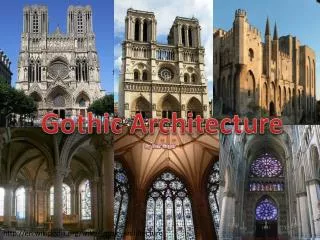
Gothic architecture, emerging in 12th-century France, is renowned for its distinctive features such as rib vaults, flying buttresses, and pointed arches. This architectural style symbolizes both structural innovation and a harmonious blend of light and space, serving as a reflection of the era’s scholarly and spiritual pursuits. The rib vaults act as a skeletal system, while flying buttresses allow for taller structures devoid of bulk. Iconic examples include the Abbey Church of Saint-Denis and Notre-Dame Cathedral, which illustrate the transformation of architectural design during the Middle Ages, expressed through intricate details and brilliant stained glass.

E N D
Gothic Architecture Architectural History ACT 322 Doris Kemp
Topics • Meaning of Gothic • Gothic Characteristics • Rib Vaults • Flying Buttress • Pointed Arch • Gothic Architecture in France
Gothic Architecture • Meaning of Gothic • “Dark Age” • Invading barbarians from the north ruined ancient art and replaced it with their own culture • Goths took Rome in 410 • Wrought little damage but became known as the first tribe of barbarians and thus the name “Gothic”
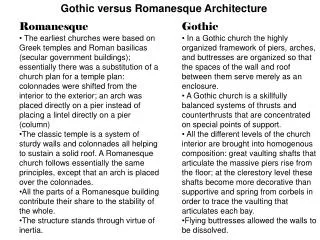
Gothic Architecture • Characteristics • Structural • Skeletal stone structure • Visual • Visual arts were important including the role of light in structures • Symbolic • Scholasticism • Translations of real events into stone and glass • Cathedrals served as an image of heaven
Gothic Architecture: The Rib Vault • Rib Vaults • Organic metaphor alluding to the role of ribs in anatomy as the body’s skeletal structure supporting tissues • Arches, usually three pairs per rectangular bay, running diagonally • Cross ribs act together with outer frame to create a complete armature of arches along the edges and main folds of the vault
Gothic Architecture: The Rib Vault Photo: Sullivan
Gothic Architecture: The Flying Buttress • Flying Buttress • Effected by powerful external arches swung above the side aisles and the ambulatory • Arches rise from colossal freestanding piers • Absorb and channel disruptive forces, such as wind and weight, safely to the ground • Towering piers could be erected without much affecting the nave or choir interior
Gothic Architecture: The Flying Buttress Photo: Sullivan
Gothic Architecture: The Pointed Arch • Builders turned from the semicircular, unbroken arch to the pointed arch • Looked lighter and pointed upward • Exert less thrust than semicircular arch of the same span • Solves geometric difficulty inherent in ribbed vaults • Impossible to arrange all arches and ribs to a common level using exclusively semicircular ribs • With a pointed arch, ribs could easily be made level
Gothic Architecture: The Pointed Arch Photo: Sullivan
Gothic Architecture: Gothic Architecture in France • First Early Gothic Style • Roots stem back to 11th century Normandy • Abbey Church of St. Etienne, Caen • Wall changed into mass-dissolving double shells and gathered into linear columnar elements
Gothic Architecture: Gothic Architecture in France Photo: Sullivan
Gothic Architecture: Gothic Architecture in France • First coherent example of Gothic architecture • Appear in Gothic 12th century Paris • Ile-de-France • Cut stone masonry employed into vaulting, rather than rubble masonry of the Normans • Arches and ribs designed with independent curvatures
Gothic Architecture: Gothic Architecture in France • Abbey Church of St. Denis • Definitive turning point in early French Gothic • Space, light, line, and geometry create transcendent modernist architectural vision Photo: Sullivan
Gothic Architecture: Gothic Architecture in France Photo: Sullivan
Gothic Architecture: Gothic Architecture in France • Abbot Suger • One of Gothic architectures most significant architects • Elected the abbot of St. Denis in 1122 A. D. • In 1137, he began to enlarge St. Denis • Built a new west front and narthex • He was very conscious of colored light and introduced two large stained glass windows to the expansion
Gothic Architecture: Gothic Architecture in France Photo: Sullivan
Gothic Architecture: Gothic Architecture in France Photo: Sullivan
Gothic Architecture: Gothic Architecture in France • Gothic came to be associated with urban settings and the extension of the French King’s political influence • Two important French gothic structures preceding Suger • Cathedral of Notre-Dame at Laon • Cathedral of Notre-Dame at Paris
Gothic Architecture: Gothic Architecture in France • Cathedral of Notre-Dame at Laon • Begun about 1165 to replace an older structure • Completed about 1205 • In the 13th century restoration occurred • Flying buttresses were added to modernize the appearance • Retained several elements from Romanesque architecture • Long nave, lantern crossing towers, and a semicircular choir
Gothic Architecture: Gothic Architecture in France Photo: Sullivan
Gothic Architecture: Gothic Architecture in France Photo: Sullivan
Gothic Architecture: Gothic Architecture in France • Cathedral of Notre-Dame at Paris • Bishop of Paris began construction in 1163 • A very tall church, reaching some 108 feet from the floor to the crown of the vaults • The clerestories were enlarged around 1225 to bring in additional light • Not as well preserved as at Laon
Gothic Architecture: Gothic Architecture in France Photo: Sullivan
Gothic Architecture: Gothic Architecture in France Photo: Sullivan
Gothic Architecture: Gothic Architecture in France Photo: Sullivan
Gothic Architecture: Gothic Architecture in France Photo: Sullivan
Gothic Architecture: Gothic Architecture in France • Notre-Dame, Paris • West front has a solid quality • Triple portals • Gallery of Kings • Represents twenty-eight kings of the Old Testament Photo: Sullivan
Gothic Architecture: Gothic Architecture in France Photo: Sullivan
References • Sullivan, Mary; http://www.bluffton.edu/~sullivanm/ • http://www.brynmawr.edu/Acads/Cities/wld/wdpt1.html • Trachtenburg/Hyman; Architecture: From Prehistory to Postmodernity • Wodehouse/Moffett; A History of Western Architecture
Gothic Architecture Architectural History ACT 322 Doris Kemp