Understanding Diminutives: Expressing Smallness and Affection in Spanish
Diminutives in Spanish convey smallness, youth, or intimacy. They often surprise English speakers with their use. For instance, "perro" becomes "perrito" (puppy) and "gato" turns into "gatito" (kitten), while family terms like "abuela" (grandmother) transform to "abuelita" (grandma). Diminutives also appear in place names, like "pueblo" to "pueblocito" (little town). Explore how diminutives enrich language and culture, creating endearment and closeness through simple suffixes.

Understanding Diminutives: Expressing Smallness and Affection in Spanish
E N D
Presentation Transcript
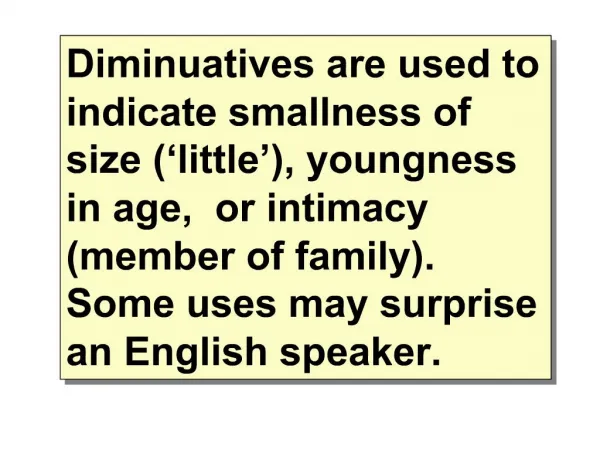
Diminuatives are used to indicate smallness of size (‘little’), youngness in age, or intimacy (member of family). Some uses may surprise an English speaker. Diminuatives using -ito
Perro = dog perrito = ? puppy
gato = cat gatito = ? kitty
oso = bear osito = ? bear cub or teddy bear
mesa = table mesita = ? little table
señora = Mrs. señorita = ? Miss
chica = girl chiquita = ? little girl
abuela = grandmother abuelita = ? grandma
abuelo = grandfather abuelito = ? grandpa
hermano = brother hermanito = ? little brother
burro = donkey burrito = ? little donkey
mamá = mom mamacita = ? mommy
mosca = fly mosquito = ? little fly
Diminuatives can also be used with names of people and places. Sometimes these are nicknames, sometimes they are not.
pueblo = town pueblocito = ? little town
cerro = hill Cerritos = ? little hills City in Southern California near Long Beach
Juana Juanita
Pepé Pepito
Miguel Miguelito
Lupe Lupita