Understanding Minerals: Composition, Formation, and Identification Techniques
Minerals are naturally occurring, inorganic solids with a definite composition and orderly atomic arrangement. They form crystalline patterns, which can be categorized based on their crystal systems. Crystals develop from magma as it cools, or from solutions when minerals dissolve in water and evaporate. The most common group is silicates, rich in silicon and oxygen. Mineral identification involves examining aspects such as color, hardness (Mohs Scale), luster, specific gravity, streak, cleavage, and fracture patterns to accurately recognize various minerals.

Understanding Minerals: Composition, Formation, and Identification Techniques
E N D
Presentation Transcript
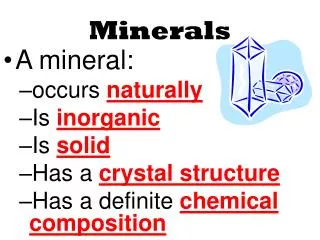
What is a Mineral • Minerals are naturally occurring, inorganic solid, with definite composition, and in an orderly arrangement of atoms
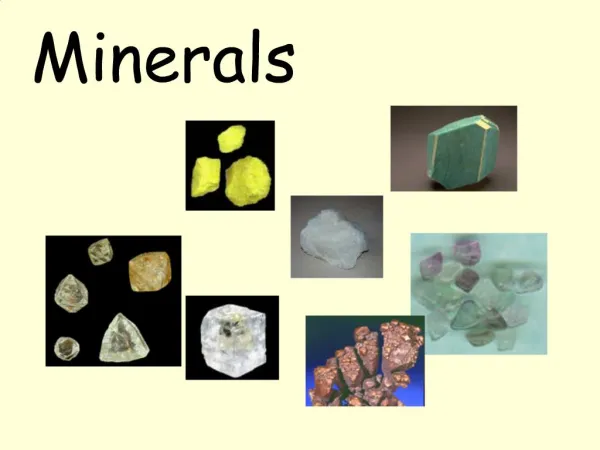
Atom patterns • When atoms are arranged in a pattern that is repeated over and over again it is called crystalline • Minerals have crystalline patterns • Graphite is arranged in layered patterns.
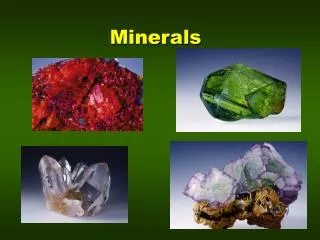
Structure of minerals • Crystals are solid in which atoms are arranged in orderly repeating patterns • A crystal system is a group of crystals that have similar atomic arrangements and thus similar external patters • Crystals that have a place to develop show the crystal patterns like figure 2, if no space is provided the arrangement is still there but no place to show it (figure 2)
Crystals from Magma • Magma is hot molted rock • If it reaches the surface, it is called lava where it can cool quickly. If it cools quickly, crystals don’t have to form (obsidian). • As magma cools, either under surface or at surface, the atoms lose heat, move together to combine into compounds thus forming specific minerals • When magma cools slowly crystals form that can be seen (granite)
Crystals form from solutions • When minerals are dissolved in water and slowly evaporate, crystals form (halite)
Mineral composition and Groups • Silicates are the most common rock forming groups containing silicon and oxygen • Si and O are most abundant element in earth’s crust
Mineral Identification • Color is true for some minerals, not all so scientists rely on several techniques to identify minerals • Hardness: how easily a mineral can be scratched according to Mohs Scale (finger nail, penny, nail, glass)) table 1 • Luster: the way light reflects off a mineral (metallic and non metallic) • Specific Gravity (how heavy a mineral is in relation to water 1 g/cm3
Mineral Identification • Streak: rubbed against a un-porcelain plate it leaves a particular color • Cleavage and fracture: Minerals break along smooth flat surfaces have cleavage (mica) • Those minerals that break with uneven jagged edges have fracture