Master Theorem: Analyzing Recursive Algorithms Efficiency
Learn to analyze recursive algorithm efficiency asymptotically using Master Theorem. Explore its conditions, pitfalls, and examples with detailed explanations. Understand the fourth condition for polylogarithmic functions.

Master Theorem: Analyzing Recursive Algorithms Efficiency
E N D
Presentation Transcript
Master Theorem Section 8.3 of Rosen Spring 2013 CSCE 235 Introduction to Discrete Structures Course web-page: cse.unl.edu/~cse235 Questions: Piazza
Outline • Motivation • The Master Theorem • Pitfalls • 3 examples • 4th Condition • 1 example
Motivation: Asymptotic Behavior of Recursive Algorithms • When analyzing algorithms, recall that we only care about the asymptotic behavior • Recursive algorithms are no different • Rather than solving exactly the recurrence relation associated with the cost of an algorithm, it is sufficient to give an asymptotic characterization • The main tool for doing this is the master theorem
Outline • Motivation • The Master Theorem • Pitfalls • 3 examples • 4th Condition • 1 example
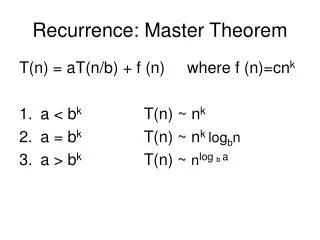
Master Theorem • Let T(n) be a monotonically increasing function that satisfies T(n) = a T(n/b) + f(n) T(1) = c where a 1, b 2, c>0. If f(n) is (nd) where d 0 then
Master Theorem: Pitfalls • You cannot use the Master Theorem if • T(n) is not monotone, e.g. T(n) = sin(x) • f(n) is not a polynomial, e.g., T(n)=2T(n/2)+2n • b cannot be expressed as a constant, e.g. • Note that the Master Theorem does not solve the recurrence equation • Does the base case remain a concern?
Master Theorem: Example 1 • Let T(n) = T(n/2) + ½ n2 + n. What are the parameters? a = b = d = Therefore, which condition applies? 1 2 2 1 < 22, case 1 applies • We conclude that • T(n) (nd) = (n2)
Master Theorem: Example 2 • Let T(n)= 2 T(n/4) + n + 42. What are the parameters? a = b = d = Therefore, which condition applies? 2 4 1/2 2 = 41/2, case 2 applies • We conclude that
Master Theorem: Example 3 • Let T(n)= 3 T(n/2) + 3/4n + 1. What are the parameters? a = b = d = Therefore, which condition applies? 3 2 1 3 > 21, case 3 applies • We conclude that • Note that log231.584…, can we say that T(n) (n1.584) No, because log231.5849… and n1.584 (n1.5849)
Outline • Motivation • The Master Theorem • Pitfalls • 3 examples • 4th Condition • 1 example
‘Fourth’ Condition • Recall that we cannot use the Master Theorem if f(n), the non-recursive cost, is not a polynomial • There is a limited 4th condition of the Master Theorem that allows us to consider polylogarithmic functions • Corollary: If for some k0 then • This final condition is fairly limited and we present it merely for sake of completeness.. Relax
‘Fourth’ Condition: Example • Say we have the following recurrence relation T(n)= 2 T(n/2) + n log n • Clearly, a=2, b=2, but f(n) is not a polynomial. However, we have f(n)(n log n), k=1 • Therefore by the 4th condition of the Master Theorem we can say that
Summary • Motivation • The Master Theorem • Pitfalls • 3 examples • 4th Condition • 1 example