Binary Ionic Compounds: Transition Metals
Binary Ionic Compounds: Transition Metals. Science 10 Chemistry Unit. Multivalent Ions. We are going to learn how to name binary ionic compounds where the metals (or cations) can form more than one ion… multi-valent ions .

Binary Ionic Compounds: Transition Metals
E N D
Presentation Transcript
Binary Ionic Compounds: Transition Metals Science 10 Chemistry Unit
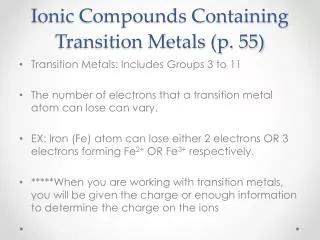
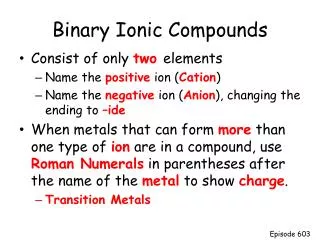
Multivalent Ions • We are going to learn how to name binary ionic compounds where the metals (or cations) can form more than one ion…multi-valent ions. • These multivalent ions are usually transition metals and can usually be found in Groups 3-12. Examples: Iron and Cobalt…Symbol & Charge?
Stock System • The method we will use is called the Stock System • Named after Alfred Stock (1876-1946), a German chemist. • We use Roman Numerals to represent the charge of the multivalent ion.
Problem 1:Write the name of FeCl2 • Write the name of the cation … but iron has more than one choice…which one will we use? • Look at the charge of the anion and also look at the subscript.
Does the cation have a subscript? • Use Roman Numerals to identify the charge of the cation. The value of the Roman number equals the positive charge on the cation. • Write the name of the anion with an "ide."
Try naming these compounds: • CuCl2 • Fe2O3 • SnO
Problem 2:Write the formula for copper (II) chloride • Write the symbol of the metal ion. The Roman numeral WILL tell you the charge on the cation. In this case it is a positive two. • Write the symbol of the anion and charge. • Remember the rule that a formula must have a net or overall chargeof zero… you can cross multiply. • The formula is
Write the formula for these compounds: • copper (I) oxide • iron (III) sulfide • tin (IV) phosphide
Important Note: • Do not use prefixes…they are for molecular or covalent compounds (two non-metals or metalloids)
Write the correct name or formula for the following: • CuS _____________________________ • PbBr4_____________________________ • Pb3N2_____________________________ • Fe2O3_____________________________ • FeI2_____________________________ • Sn3P4_____________________________ • Cu2S_____________________________
Write the correct name or formula for the following: • SnCl2_____________________________ • HgO_____________________________ • Iron (II) chloride ____________________________ • Copper (I) sulfide ____________________________ • Lead (IV) iodide ____________________________ • Tin (II) fluoride _____________________________ • Mercury (I) bromide _________________________ • Tin (II) oxide ____________________________ • Chromium (III) oxide__________________________