Linear Algebra
Explore the foundational concepts of vectors and matrices in linear algebra. Vectors, represented as arrows in space, have properties like magnitude and direction. Learn about operations such as addition, subtraction, and the dot product. Discover matrices, their multiplication rules, and the significance of square matrices and their inverses. Dive into eigenvalues and eigenvectors, which describe how matrices scale and rotate vectors. This guide demystifies these concepts, enabling insights into higher dimensions and applications in areas like web page ranking.

Linear Algebra
E N D
Presentation Transcript
vectors and matrices • A vector is a bunch of numbers • A matrix is a bunch of vectors
A vector in space • In space, a vector can be shown as an arrow • starting point is the origin • ending point are the values of the vector
Properties of vectors • Its “size” |v| • the 2-norm of the vector |(1, 2, 3)| = √(12 + 22 + 32) • A unit vector is a vector of size 1.
Operations on vectors • Addition, Subtraction – easy. (1, 2, 3) + (100, 200, 300) = (101, 202, 303) • Dot product (1, 2, 3)•(100, 200, 300) = (100, 400, 900) • Multiplication – with other matrices. • Division – not defined.
Matrices • No intuitive representation in space. • Addition / Subtraction – easy • Multiplication – matrix multiplication • Not commutative • Division – not defined • If the matrix is • a square matrix • invertible • then take inverse and multiply
Matrix Multiplication can be seen as computing vector dot products.. • Given a matrix R, you can consider each row of M as a vector. • Thus R = [r1 r2 .. rk] • Now Given another matrix S whose column vectors are s1… sk, the ijth element in R*S is ri.sj • . Is the dot product • As a corollary, if a matrix M is orthogonal—i.e., its row vectors are all orthogonal to each other, then M*M’ or M’*M will both be diagonal matrices..
Some identities / properties • transpose of a matrix • determinant of a matrix • A A-1 = I
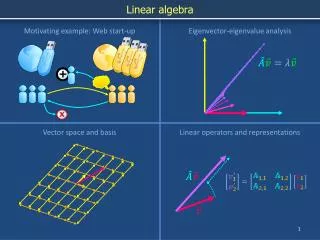
What happens when you multiply a matrix by a vector? • The vector scales and rotates.
So a matrix is a bunch of numbers that tells us how to rotate and scale vectors • Special matrices: Unit matrix • Special matrices: Rotation matrix • Special matrices: Scaling matrix
Can we make some general statements about a matrix? • Given any matrix M, can we make some statements about how it affects vectors? • Start with any vector. Multiply it over and over and over with a matrix. What happens?
Eigen vectors • There are some vectors which don’t change direction on multiplication with a matrix. • They are called Eigen vectors. • However, the matrix does manage to scale them. The factor it scales them by, are called the ‘Eigen values’.
How to find Eigen values • Let’s assume one of the eigen vectors is v • Then Av = λv, where λ is the eigenvalue. • Transpose it (A - λI)v = 0 • Theorem: if v is not zero, then the above equation can only be true if the determinant of (A – λI) is zero. [proof: see Characteristic polynomial in Wikipedia] • Use this fact to find values of λ
How to find Eigen Vectors • Substitute λ back into the equation (A - λI)v=0 • Try to find v • You will get two equations in two variables – but: there is a problem, the two equations are identical
Eigen vectors – the missing eqn • One equation, two variables • Use the additional constraint that the Eigen vector is a unit vector (length 1) • x12+x22 = 1 • Using the x1 = x2 we found from the previous slide, we have the Eigen vector
So what do these values tell us • If you repeatedly multiply a vector by a matrix, (and then normalize), then you will eventually get the primary Eigen vector. • The primary Eigen vector is, sort of, the general direction in which the matrix turns the vector
How is this all relevant to the class? • Instead of thinking of 2-dimension or 3-dimension vectors, imagine vectors in T dimensions • T = number of different terms. • Each doc will be a vector in this space. • Similarity between the docs = normalized dot product • Store the link structure of the web in a matrix • Eigen values / vectors – PageRank