Assessing Land-Use Changes on African Monsoon Precipitation: A Simulation Study
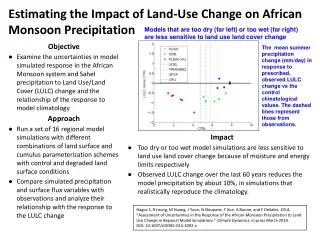
This study investigates how land-use and land-cover (LULC) changes impact precipitation in the African Monsoon system, particularly in the Sahel region. We run 16 regional model simulations using various land surface parameterizations to analyze the response to LULC changes. Findings reveal that models overly dry or wet show reduced sensitivity to land use changes due to moisture and energy constraints. Over the last 60 years, observed LULC changes have led to a 10% reduction in simulated precipitation, highlighting the importance of accurate climatological representation in regional simulations.

Assessing Land-Use Changes on African Monsoon Precipitation: A Simulation Study
E N D
Presentation Transcript
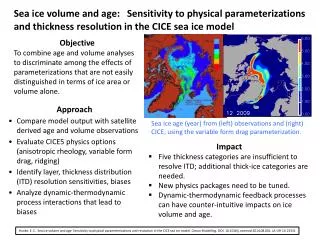
Estimating the Impact of Land-Use Change on African Monsoon Precipitation Models that are too dry (far left) or too wet (far right) are less sensitive to land use land cover change Objective • Examine the uncertainties in model simulated response in the African Monsoon system and Sahel precipitation to Land Use/Land Cover (LULC) change and the relationship of the response to model climatology Approach • Run a set of 16 regional model simulations with different combinations of land surface and cumulus parameterization schemes with control and degraded land surface conditions • Compare simulated precipitation and surface flux variables with observations and analyze their relationship with the response to the LULC change The mean summer precipitation change (mm/day) in response to prescribed, observed LULC change vs the control climatological values. The dashed lines represent those from observations. Impact • Too dry or too wet model simulations are less sensitive to land use land cover change because of moisture and energy limits respectively • Observed LULC change over the last 60 years reduces the model precipitation by about 10%, in simulations that realistically reproduce the climatology. Hagos S, R Leung, M Huang, J Yoon, N Neupane, Y Xue, A Boone, and F DeSales. 2014. “Assessment of Uncertainties in the Response of the African Monsoon Precipitation to Land Use Change in Regional Model Simulations.” Climate Dynamics, in press March 2014. DOI: 10.1007/s00382-014-2092-x