Download
1 / 24
240 likes | 370 Views
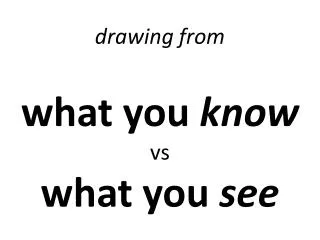
d rawing from w hat you know vs w hat you see. to draw… to extract …. to know… an understanding of, a knowledge of… it’s a mentally formed image of something, an idea formed in the mind, a conceptual struggle….

E N D
to know…an understanding of, a knowledge of… it’s a mentally formed image of something, an idea formed in the mind,a conceptual struggle…
to see…is a visual effort, optically received by the eyes, it’s more concrete
In the context of the Art & Design, there is EPADE – Elements &P – PrinciplesA – Art &D – Design
All things around us, other than knowingwhat they are (as ideas), can also be experienced using these visual elements –at the visual level
To experience them with our knowledge is an instinctive human behavior but learning to see is an acquired skill set
Drawing from what you see and not what you know…is less comfortable
You as the MAKERThe what, when, where, why, who and howof these elements and the arrange of themYou as the AUDIENCE
Your experiences seeing things at visual level not only enable you to make visuals with discerning eyes, it makes appreciation / interpretation of things around more meaningful
Is seeing discussed here the same as what Berger has covered in ‘Ways of Seeing’?
What about sounds that you hear, can they be discussed at different levels?
Your experience of the (art)world, is it a more conceptual or a visual one?
To see something as art requires something the eye cannot descry –an atmosphere of artistic theory, a knowledge of history of art: an artworldArthur Danto
KeywordsAssumption, Contexts, cognition, perception,aesthetic, process/outcome, World of Forms, Plato's Allegory of the Cave, Dialogues of Plato, forms/forma, ideas, Arthur Danto