Collaborative Robotics Design: Essential Team Dynamics for Engineering Success
This course introduces students to the principles of working in multidisciplinary teams within robotics. Emphasis is placed on understanding team dynamics, roles, and effective communication strategies necessary for successful project completion. Students will perform lab assignments, design a robot for an Urban Search & Rescue Project, and conduct team meetings that enhance decision-making and conflict resolution. By exploring characteristics of successful team members and employing creative problem-solving techniques, students will gain hands-on experience in building collaborative systems.

Collaborative Robotics Design: Essential Team Dynamics for Engineering Success
E N D
Presentation Transcript
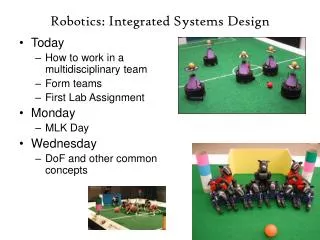
Robotics: Integrated Systems Design • Today • How to work in a multidisciplinary team • Form teams • First Lab Assignment • Monday • MLK Day • Wednesday • DoF and other common concepts
What is a Team? • Two or more people who interact with each other, are interdependent, and define themselves and are defined by others as a team. • Otherwise you are a group ( or a party).
What else is a Team? • Two or more people who work together to achieve a common purpose • What will be your team’s common purpose in this class? • To perform the lab assignments • To design and implement a robot for the Urban Search & Rescue Project • To learn about each other areas from one another
Team Process • How are decisions made? • How are conflicts resolved? • Team Roles • CTO: Chief Technical Officers (Facilitator) • Keeps the team focused and productive • Scribe • Documents the activities and decisions of the team • Rat Hole Watcher • Makes sure the team doesn’t get too far off topic
Running an Effective Team Meeting • Meetings must have a detailed agenda • What topics are to be covered, what activities will be performed • Team Roles Assigned • CTO, Scribe, Rate Hole Watcher • Document the Meeting • What was discussed or accomplished • What are the “action items” and who is responsible for each one. • Provides a group memory • Reminds individuals the assignments they need to complete
Team Meeting Exercise • Get into your assigned teams • Introduce each other and trade contact information • Run a 10-minute team meeting • Assign roles, use the meeting minutes template • Here is the meeting agenda: • Individual team members list 5 characteristics of a good team member • Individual team members list 5 characteristics of a poor team member • As a team come to a consensus of a top 5 list for good characteristics and poor characteristics in order of priority.
Review Lists My list of top 5 “Do Be’s” • Completes assignments on time • Communicates • Uses constructive criticism rather than destructive criticism. • Is on time for meetings • Sense of humor
Puzzle Game Form Teams Solve the given jigsaw puzzle without looking at the picture
What did we observe? • It is difficult to solve the puzzle without having a clear picture of what the objective is • Team members automatically assumed certain roles based on their personality types and styles
Brainstorming • Conceptual Blocks Impede your ability to generate alternatives and make you fixated on certain ideas. Stereotyping Generalizing Making unwarranted assumptions
Types of Mental Blocks • Perceptual • Emotional • Cultural • Environmental • Intellectual • Expressive
To Think Creatively, use other people’s view Creative Thinking Methods • Vertical Thinking • Lateral Thinking • Futuring
Example • An Electric Plant in Great Lakes area is having problems with zebra mussels. The mussels are forming a thick layer inside the cooling intake and reducing flow rate resulting serious problems in the plant. Since they are not a native species to the area there are no natural predators. How can we reduce the impact of the mussels? Also, how to economically dispose them once removed?
Team Assignment • Build a Rube Goldberg Machine using your Lego Kits • http://www.cs.siue.edu/robotics/integratedsystems/