Download
1 / 1
20 likes | 133 Views
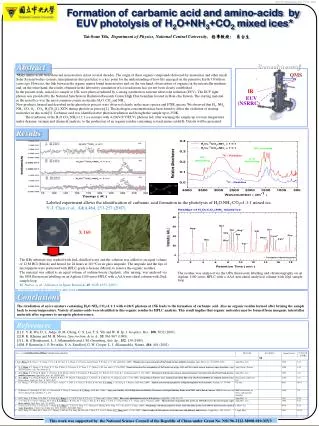
This experimental study investigates the formation of carbamic acid and amino acids through the EUV photolysis of a mixed ice sample at 15K consisting of H2O, NH3, and CO2. The research reveals the clear observation of new products in the photolysis process, including hydrogen-concentration effects on molecule oxidation and the identification of carbamic acid and amino acids. The results imply the formation of organic molecules from inorganic interstellar materials exposed to energetic photon sources. The study provides insights into the origins of organic compounds in meteorites and Solar System bodies, contributing to understanding life's emergence on early Earth.

E N D
IAU251, Hong Kong, Feb. 18~22, 2008 Formation of carbamic acid and amino-acids by EUV photolysis of H2O+NH3+CO2 mixed ices* Tai-SoneYih, Department of Physics, National Central University, 指導教授: 易台生 Abstract Experimental Setup QMS Many amino acids were detected in meteorites in last several decades. The origin of these organic compounds delivered by meteorites and other small Solar System bodies (comets, interplanetary dust particles) is a key point for the understanding of how life emerged on the primitive Earth 3.8 billion years ago. However, the link between the organic matter found in meteorites and, on the one hand, observations of organics in the interstellar medium and, on the other hand, the results obtained in the laboratory simulation of ice irradiations has yet not been clearly established. In the present work, mixed ice sample at 15K were photo-irradiated by a strong synchrotron extreme ultraviolet radiation (EUV). The EUV light photon was provided by the National Synchrotron Radiation Research Center High Flux beamline located in Hsin-chu Taiwan. The starting material in the mixed ice was the most common cosmic molecules H2O, CO2 and NH3. New products formed and desorbed in the photolysis process were observed clearly in the mass spectra and FTIR spectra. We observed that H2, NH2, NH3, CO, O2 , CO2, H2CO3[1], XCN during photolysis process[2]. The hydrogen concentration has been found to affect the oxidation of starting molecules in this work[3]. Carbamic acid was identified after photon irradiation and brought the sample up to 250K. The irradiation of the H2O:CO2:NH3=1:1:1 ice mixture with 4-20eV(UV/EUV) photons led, after warming the sample up to room temperature under dynamic vacuum and chemical analysis, to the production of an organic residue containing several amino acids[4]. Details will be presented. IR EUV (NSRRC) Results X 160 The KBr substrate was washed with 1mL distilled water and the solution was added to an equal volume of 12 M HCl (Merck) and heated for 24 hours at 110 ℃ in an glass ampoule. The ampoule and the tips of micropipette were pretreated with HPLC grade n-hexane (Merck) to remove the organic residues. The material was added to an equal volume of sodium borate (Agilent), after mixing, was analysed via the OPA fluorescent labelling on an Agilent 1100 series HPLC with a AAA non-chiral column with 20μL sample loop. M. Nuevo, et al., Advances in Space Research, 40, 1628-1633 (2007). The residue was analysed via the OPA fluorescent labelling and chromatography on an Agilent 1100 series HPLC with a AAA non-chiral analytical column with 20μl sample loop. After irradiated to a 1020 photon dose, the residue is observed clearly A microscopic view Conclusions The irradiation of an ice mixture containing H2O:NH3:CO2=1:1:1 with 4-20eV photons at 15K leads to the formation of carbamic acid. Also an organic residue formed after brining the sample back to room temperature. Variety of amino-acids were identified in this organic residue by HPLC analysis. This result implies that organic molecules may be formed from inorganic interstellar materials after exposure to energetic photon source. [1] C. Y. R. Wu, D. L. Judge, B. M. Cheng, C. S. Lee, T. S. Yih and W. H. Ip. J. Geophys. Res.,108, 5032 (2003). [2] R. K. Khanna and M. H. Moore, Spectrochim. Acta. A.,55, 961-967 (1999). [3] L. B. d’Hendecourt, L. J. Allamandola and J. M. Greenberg, Astr. Ap., 152, 130 (1985). [4]M. P. Bernstein, J. P. Dworkin, S. A. Sandford, G. W. Cooper, L. J. Allamandola, Nature, 416, 401 (2002). This work was supported by the National Science Council of the Republic of China under Grant No. NSC96-2112-M008-010-MY3 Labeled experiment allows the identification of carbamic acid formation in the photolysis of H2O:NH3:CO2=1:1:1 mixed ice. Y.-J. Chen et al., A&A 464, 253-257 (2007) References