Download
1 / 16
160 likes | 272 Views
This lesson covers the fundamental properties of addition for real numbers, focusing on the Commutative, Associative, Identity, and Inverse Properties. It also defines opposites, absolute values, and provides rules for adding numbers with the same or different signs. Examples illustrate how to apply these concepts in practice. By the end, learners will be able to confidently add real numbers, understand relationships between opposites, and calculate absolute values. Engage with practice problems to reinforce your understanding and mastery of these essential math skills.

E N D
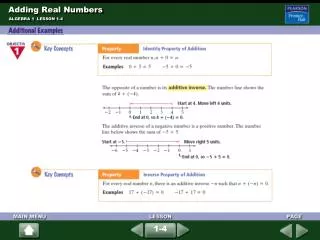
Properties of Addition • Commutative Property – changing the order of numbers being added does not change the sum. • EX. 3 + (-2) = (-2) + 3 • Associative Property – Grouping does not change the sum when adding. • EX. (-5 + 6) + 2 = -5 + (6 + 2)
Properties of Addition (cont.) • Identity Property – The sum of a number and 0 is the number. • EX. - 4 + 0 = - 4 • Inverse Property – The sum of a number and its opposite is zero. • EX. 5 + (-5) = 0
What are Opposites? • Two integers the same distance from the origin, but on different sides of zero • Every positive integer has a negative integer an equal distance from the origin • Example: The opposite of 6 is -6 • Example: The opposite of -2 is 2
Practice With Opposites Opposite of -13 Opposite of 6 Opposite of -67 Opposite of 52
What is Absolute Value? • Distance a number is from zero on a number line (always a positive number) • Indicated by two vertical lines | | • Every number has an absolute value • Opposites have the same absolute values since they are the same distance from zero • Example: |-8| = 8 and |8| = 8 • Example: |50| = 50 and |-50| = 50
Practice With Absolute Value |12| = |-95| = |-17| = |1/2| = |10| = |0| =
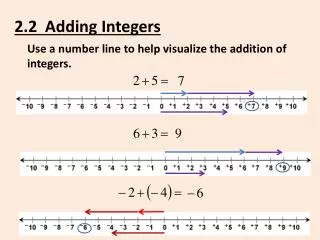
Adding Rules – Same Signs • If the numbers have the SAMEsigns: ADD the numbers & keep the same sign! • Positive + Positive = Positive Answer • Negative + Negative = Negative Answer • Examples: -3 + (-10) = -13 • 6 + (8) = 14
Adding (Same Signs) - Examples • - 15 + (-12) = • -8 + (-9) + (-2) =
Adding (Same Signs) - Examples • 3) (-3.5) + (-2) = • 4) -2 + (-3.4) + (-2.1) =
Adding Rules – Different Signs • If the numbers have the DIFFERENT signs: SUBTRACT the numbers & use sign of the BIGGERnumber! • Bigger # is Positive = Positive Answer • Bigger # is Negative = Negative Answer • Examples: -13 + (7) = -6 • 23 + (-8) = 15
Adding (Different Signs) - Examples • 25 + (-17) • 4 + (-8) + 2
Adding (Different Signs) - Examples • 3) (-18.5) + 12 • 4) (-9.2) + 10
Adding (Different Signs) - Examples • -4 + 10 + (-6) • 6) 6.8 + 3.3 + (-4.1)
Notecard Check -10 + 12 9 + (-1.7) 1.5 + (-5.6) + 1
Homework • Pg. 75 • Numbers: 1, 11, 21 – 36.