Exploring Gypsum Crystals of Naica Mountain: A Comprehensive Guide to Mineral Properties
Discover the fascinating world of gypsum crystals found in Naica Mountain, Mexico. Gain insights into what constitutes a mineral, including its natural occurrence, inorganic solid form, specific chemical composition, and unique crystal structure. Learn about key mineral properties such as crystal form and growth habits, luster, hardness, and specific gravity. Explore the distinctions between cleavage and fracture, and delve into other intriguing characteristics like color, streak, and unique reactions. This guide is an essential resource for mineral enthusiasts and geology students alike.

Exploring Gypsum Crystals of Naica Mountain: A Comprehensive Guide to Mineral Properties
E N D
Presentation Transcript
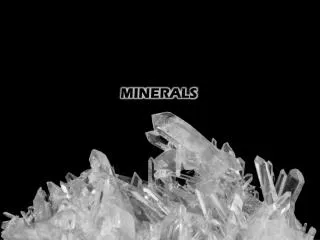
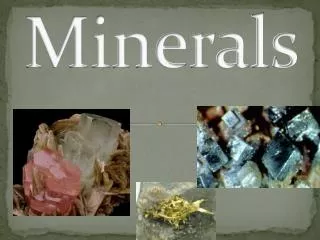
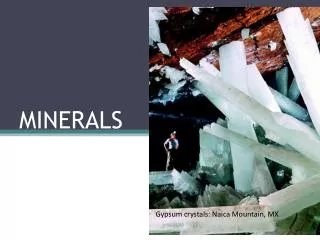
MINERALS Gypsum crystals: Naica Mountain, MX
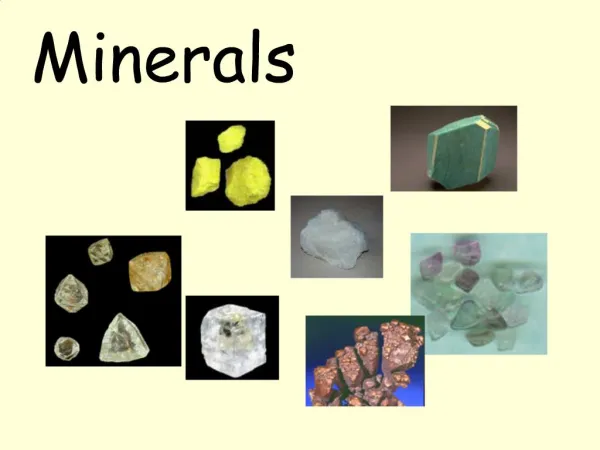
What is a mineral? • Naturally Occurring • Inorganic Solid • Specific Chemical Composition • Characteristic Crystal Structure • Regular geometric arrangement of atoms
Mineral Properties • Crystal form/Growth habit • Luster • Hardness • Specific Gravity • Streak • Cleavage • Fracture • Color • Other Properties
Crystal Form/Growth Habit • Shape that occurs when a mineral grows freely • Acicular – needle-like • Globular – hemispherical masses • Fibrous – extremely slender prisms • Octahedral – eight sided • Radiating – radiating outward from a central point
Luster • A description of the way light interacts with the surface of a crystal or mineral • Metallic: This has a shiny surface, resembling polished metal. Reflective. • Non-metallic: This as a surface that does not shine or reflect light well.
Hardness • A measure of how much a mineral resists being scratched. • We use Mohs scale of hardness to rate the hardness of minerals. • Devised by German mineralogist, Frederich Mohs • Scale is arbitrary
FOR THIS LAB: You can use the following materials and the list of the hardnesses of them to determine hardness for each mineral.
Specific Gravity (SG) • The ratio of the density of a given solid or liquid substance to the density of water at a specific temperature and pressure, typically at 4°C (39°F) and 1 atm (14.7 psi). • Value is dimensionless, there are no units
Streak • The color of the powder left when scratched across a porcelain plate
Cleavage • Description of how a mineral breaks • To determine what is a cleavage plane look for the following: • A smooth break along a crystal plane • A reproducible face—the mineral is broken along the same faces multiple times in one sample • Describe cleavage using: perfect, imperfect, good, distinct, indistinct, and poor
Fracture • If there is no plane of weakness, then the breaks will not be the same • Conchoidal fracture swirls • Non-Conchoidal fracture has no pattern
What’s the difference between cleavage and fracture? • Cleavage: breakage along planes of atomic weakness within a crystal. Look for a distinct “pattern” of breakage. Don’t confuse breakage pattern with crystal form (how it grows). • Fracture: Irregular breakage displayed by minerals with uniform atomic arrangement.
Color (Occasionally distinctive, but can be deceiving) Hey look five different minerals! Wrong, all calcite
Other Properties • Reacts with Acid • Salty • Magnetic • Labradorescence