Suzanne Lockhart
This thesis by Suzanne Lockhart, a PhD candidate at the University of S.A., investigates community perceptions of biometric technology amidst rising concerns over identity fraud. It examines the displacement effects and the diffusion of benefits related to enhanced identity infrastructures. The research explores human factors influencing the adoption of biometric systems, addressing both social and personal characteristics that affect perceptions. Key findings suggest a desire for more transparency and public debate on biometric applications, alongside the importance of addressing privacy and security issues.

Suzanne Lockhart
E N D
Presentation Transcript
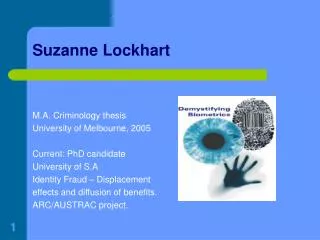
Suzanne Lockhart M.A. Criminology thesis University of Melbourne, 2005 Current: PhD candidate University of S.A Identity Fraud – Displacement effects and diffusion of benefits. ARC/AUSTRAC project.
Human identification • Moved from a social context of belonging to a group or family where associates rely on peculiarities such as appearance, voice and shared knowledge. • To a more complex process based on economic necessity.
Drivers for enhanced identity infrastructures • Terrorism – identity crimes • Globalization of economic & social life - transfer of information, goods, people and convergence of computing and communication technologies. • Australia: Whole-of-government approach to the integration of information systems, services, policies and programs.
Australian context Australian Government states: “that it intends to keep pace with the application of biometric technology to improve border protection, combat identity fraud, address passenger volume issues and meet international obligations”
Social responses • Indication that biometrics will become more widespread. • However there has been little consideration of how the community may respond to the technology.
Biometric system threats • Technical threats – software and hardware issues. Ability of the system to deal with physiological rate of change, gender, ethnicity, cost (user perspectives), direct/indirect medical implications. • Human threats – Unauthorized users, accidental and deliberate misuse. • Physical threats – natural disaster, storm, water, humidity, dust, lighting, • Theoretical threats – algorithm vulnerability, enrolment threats, physical and technical threats, circumvention, spoofing and biometric theft. • Other technical – standards, data management, interoperability etc.
Research aim – human factor issues • Identify the community perception of biometrics. • Identify and explore the variables which might influence the decision to adopt or reject biometric systems. • Applied diffusion of innovation theory (Rogers 1995). Diffusion research centers on the conditions which increase or decrease the likelihood that a new idea, product or practice will be adopted by the members of a given culture.
Diffusion theory states: The decision to adopt or reject a new idea or innovation will be influenced by: • receiver variables; social and personal characteristics, perceived need for the innovation etc; • relative advantage, compatibility, complexity, triability, observability; • time; and • communication sources.
Characteristics influencing perceptions of biometrics Perceptions will change over time and be influenced by: • Personality characteristics • Social issues
1.Personality characteristics • Emotional status – influenced by phobias, drugs, alcohol, family, reasons for using the device (airports). • Psychological status of user – ability to understand and interact with the system. • Psychological dysfunction – psychological disorder, substance related, anxiety, dissociative disorder, impulsive control, reduced intellectual capacity, age.
2. Social issues • Privacy – data sharing/mining, access, disclosure etc • Function creep • Religion • Political stance • Socio-economic status - education • Usability of the system – effective, convenient, reward, intuitive, signage • Prior victimization – offender/victim • Physical disability/health issues – wheel chair, arthritis, laryngitis, injury. • Environmental issues – climate, clothing, type of industry, access to device • Social impact – intimidation, technology experience
Results Identified that the degree of awareness and knowledge potential users may have about biometrics is directly influenced by: • personal, social and experiential characteristics; • a perceived need for the innovation; • social system variables; and • communication behavior.
Other points identified • Many were overwhelmed by using multiple passwords and PIN’s. • The level of knowledge about biometrics is low. • Health and safety is a concern. • The public would like more open debate and information about biometrics. • Majority are prepared to forgo some issues about privacy to increase more secure authentication mechanisms. • Fall back mechanism are required. • Primary concerns relate to data sharing, data security and privacy issues.
Social implications of introducing identity crime solutions such as biometrics. • Make society less trusting • Change the modus operandi • Displacement effects • Diffusion of benefits
Thank you to discuss any of these issues please contact Suzanne Lockhart Canberra 0419 545 638 suzannelockhart@virtual.net.au