Warm-Up
This lesson focuses on the concepts of empirical and molecular formulas, essential in chemistry. It explains how to derive the empirical formula from percent composition and provides step-by-step methods for calculating the molecular formula. Real-life examples are included to illustrate these calculations, such as calculating the empirical formula from given percentages of sodium, sulfur, and oxygen. Practice problems are also provided to reinforce learning, helping students master the relationships between these formulas and their applications in chemical compounds.

Warm-Up
E N D
Presentation Transcript
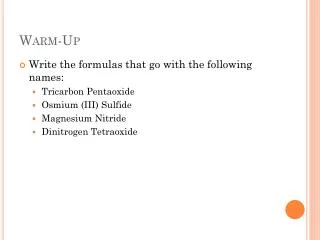
Warm-Up • Write the formulas that go with the following names: • TricarbonPentaoxide • Osmium (III) Sulfide • Magnesium Nitride • DinitrogenTetraoxide
Chemistry:Empirical and Molecular Formulas Unit Five, Day Six Kimrey 18 October 2012
Empirical Formula and Molecular Formula • Empirical formula is the simplest chemical formula • Ex. CH4 • Molecular formula is the chemical formula that can be reduced. • Molecular Formula- the formula for a compound in which the subscripts give the actual number of each element in the formulas it truly exists. • Ex. C2H8
Notice two things: 1. The molecular formula and the empirical formula can be identical. 2. You scale up from the empirical formula to the molecular formula by a whole number factor.
Calculating the empirical formula from the percent composition • Steps • Assume the percent = grams. • Convert each amount of grams to moles. • Divide each number of moles by the smallest number of moles. • If all the numbers are not whole numbers, multiple everything by a number that will get you a whole number. (This may take a few tries!) • The whole numbers become subscripts in the formula.
Percent to mass • Mass to mole • Divide by small • Multiply ‘til whole
Example • A compound is 32.38% sodium, 22.65% sulfur, and 44.99% oxygen. What is the empirical formula?
Example 2 • A compound is 40.0% Carbon; 6.71% Hydrogen; 53.29% Oxygen. What is its empirical formula?
Practice • 89.94% C; the rest is H • 56.34% P; 43.66% O • 43.64% P; 56.36% O • 40.9% C; 4.58% H; 54.5% O
Now, finding the molecular formula • Find the empirical formula • Calculate the molar mass (formula mass) • Divide the given mass of the substance by the molar mass • Multiply each subscript of the empirical formula by the answer to #3
Example • You have 56.106 grams of a substance with an empirical formula of CH2. What is the molecular formula?
CuSO4 ● 5H2O • MgSO4 ● 7H2O • SnCl2 ● 2H2O • Na2CO3 ● 10H2O