Phosphate Mobility and GHG Emissions in Wetlands: Insights from Microcosm Studies
130 likes | 261 Views
This report presents findings from a series of microcosm studies conducted by Andrew Mehring in 2013, focusing on the behavior of phosphate (PO4^3-) in submerged zones under anoxic conditions. Results indicate that anoxia enhances phosphate release, while iron (Fe) and aluminum (Al) significantly bind phosphate in upper soil layers. The research also explores the role of sediment-feeding invertebrates like chironomids and oligochaetes in increasing nitrous oxide (N2O) and methane (CH4) emissions across various wetland types. The study's outcomes contribute valuable insights into nutrient dynamics and greenhouse gas emissions in wetland ecosystems.


Phosphate Mobility and GHG Emissions in Wetlands: Insights from Microcosm Studies
E N D
Presentation Transcript
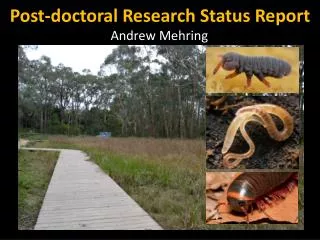
Post-doctoral Research Status Report Andrew Mehring
Microcosm study 2013 Skye sand Phosphate (PO43-) more mobile in submerged zone? Anoxia releases PO43- Iron (Fe) and aluminum (Al) strongly bind PO43- Skye Sand coated with Fe binds (PO43-) in upper layers
Microcosm study 2013 Anoxia allows Iron reduction Ferric (Fe3+) iron → Ferrous (Fe2+) iron Skoog and Arias-Esquivel 2009 – Sci. Tot. Env.
Microcosm study 2013 Soil treatments control P P + Iron oxide Fe reducers ShewanellaoneidensisGeobactermetallireducens Animalsearthworms millipedes both neither
Microcosm study 2013 Incubation period finished and animals weighed Soils homogenized and ready to ship
Wetlands – chironomidsoligochaetes and GHG emissions Sediment-feeding invertebrates enhance N2O emissions (Stief et al 2009 PNAS)
Wetlands – chironomidsoligochaetes and GHG emissions N2O emissions also enhanced by nutrient loading (NO3-)
1. Wetlands – Chironomidsoligochaetes and GHG emissions 15 wetlands 5 constructed/urban wetland 5 agricultural 5 waste stabilization or golf course Measurements N2O, CH4 emissions (response) From each core: Chironomid, oligochaete, etc. abundance NO3- Turbidity, temperature, O2 chlorophyll a Stable isotopes 13C and 15N
1. Wetlands – Chironomidsoligochaetes and GHG emissions 15 wetlands 5 constructed/urban wetland 5 agricultural 5 waste stabilization or golf course Measurements N2O, CH4, CO2emissions (response) From each core: Chironomid, oligochaete abundance NO3- [O2], turbidity, temperature Stable isotopes 13C, 15N Ecosystem metabolism
1. Wetlands – Chironomidsoligochaetes and GHG emissions 15 wetlands 5 constructed/urban wetland 5 agricultural 5 waste stabilization or golf course Measurements Repeated seasonally (4x per year) Captures seasonal changes in chironomid biomass, temperature, nutrient inputs . . .
2. Biofilters – animal community development Higher animal diversity in biofilters, compared to nearby gardens and lawns Kazemi et al 2009 – Ecological Engineering
2. Biofilters – animal community development 20 biofilters as a chronosequence 10 in Melbourne, 10 in Brisbane (potentially) Sort invertebrate abundance, biomass, and community structure Also: canopy cover distance to adjacent green spaces Soil C, N, P Soil moisture, veg cover
3. Biofilters – column study Using Monash columns, examine effects of earthworms on N dynamics, plant growth, infiltration