Minor Planets
This comprehensive overview delves into the intriguing categories of celestial bodies within our solar system, focusing on dwarf planets, asteroids, and meteoroids. It explains the defining characteristics of dwarf planets like Ceres and Pluto, the nature of asteroids and TNOs, and provides insight into the origin and composition of meteoroids. Explore the crowded spaces between planets and the significant role these objects play in understanding the evolution of our solar system, as well as the physics of differentiation and the importance of meteorites in revealing our cosmic heritage.

Minor Planets
E N D
Presentation Transcript
Minor Planets Between the meteorites and the moons.
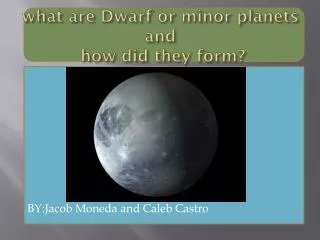
Dwarf Planets • A celestial body orbiting the Sun • Massive enough to be spherical as a result of its own gravity • Has not cleared its neighboring region of planetesimals • Is not a satellite (does not orbit another planet). • 5 currently recognized by the IAU: Ceres, Pluto, Haumea, Makemake, and Eris. • 50 – 200 other current candidates.
Asteroids • No true formal definition • Tends to refer to minor planets within the inner solar system, larger than 10 km diameter. • Can also be referred to as Planetoid or “Small Solar System Object”
Trans-neptunian objects (TNO) • ANY object that is part of the solar system and beyond the orbit of Neptune. • Kuiper Belt: • Objects from 30 – 50 A.U. (KBO = Kuiper Belt Object) • Primarily Icy, with frozen volatiles (methane, ammonia, etc.) • Scattered Disc: • Sparse collection of larger TNOs, beyond the Kuiper Belt • Similar in composition to Kuiper Belt Objects • It is now believed that most comets originated from this region. • Oort Cloud: • Farthest reaches of the solar system • Spherical in structure, instead of flat, disc shaped regions
The rest of the objects Boulders to Dust
Comets • Highly eccentric orbits • Believed to originate from the scattered disc • Many come from the Kuiper Belt or Oort Cloud as well. • Can range from “Icy mudball” to “dirty snowball” in composition.
Meteoroids • sand to boulder-sized particle of debris in the solar system • Ranges from icy to rocky to metallic • When it enters the earth’s atmosphere it becomes a METEOR • Once it lands on the surface of the earth, it becomes a METEORITE
A Crowded Solar system? • Maybe…
Solar System Fluff Not so fluffy fluff…
A Crowded Solar system? • Maybe…
Quick Volume Calculations • Area = Pi * (8x10⁸)2 - Pi * (2x10⁸)2 = 2.05 x 10¹⁸ km2 - 1.2566 x 10¹⁷ km2 = 1.885 x 10¹⁸km2 = 1,885,000,000,000,000,000 km2 • Volume = 1.885 x 10^18 km2 * 140,000 km • = 2.64 x 10²³ km3 • = 264,000,000,000,000,000,000,000 km3 • Space volume PER asteroid = • 2.64 x 10²³ km3/ 1.0 x 108= 2.64 x 10¹⁵km3 • Average distance from asteroid to asteroid = • (2.64 x 10¹⁵ km3)1/3 • = ~140000 km • Majority of asteroids are between Mars & Jupiter • Quick area calculation of that space to the right • Volume? • Assume that ALL asteroids are in a region no thicker than the diameter of Jupiter itself (140,000 km) • Assume 100 million (100,000,000) asteroids (not nearly that many…) • So then the average distance from one asteroid to another would be… • That’s 1/3 the distance to the moon.
A Crowded Solar system? • Maybe…
Differentiation • Differentiation occurs when material accretes • Compression and radiogenic decay produces heat • The Planetesimal melts • Dense material (metals) sink to the surface • The planetesimal may collide • Fragments become different types of meteoroids/asteroids
What types are out there? • C - type • Rocky (silicate) with lots of carbon compounds (think charcoal) • S – type • Rocky (silicate) without the carbon compounds • M – type • Metallic (Iron & Nickel) • Why the different types?
From the asteroids, Meteoroids • Stony Meteorites • Can be from C type asteroids OR S-type • Stony – Iron Meteorites (1% of all) • From unusual “boundary” asteroids • Iron Meteorites (2-3% of all) • From M type asteroids • Make up 40% of all “finds” however…
Chondrites • Special meteorites – Unchanged from the beginnings of the solar system. • 4.6 billion years old (beginning of the solar system • Never accreted onto a larger body • Therefore never underwent the differentiation process • Contain chondrules • Droplets of material leftover from initial condensation of the solar nebula • Carbonaceous chondrites • Contain organic molecules • Stuff for life
Why are the Irons so easy to find? • Think about it… vs.
Not all are so easily categorized however… • We sometimes get splattered with debris from distant impacts.
Radioactive Dating • It works.
A REMINDER about terminology! • Meteoroid – Meteor – Meteorite. • Space – Atmosphere – Ground.