
Essential Concepts of Mesopotamia: A Comprehensive Study Guide
This study guide covers the key concepts of Mesopotamia, the "Cradle of Civilization," focusing on its geography, culture, laws, and societal structure. Students will explore vital topics such as Hammurabi's Code, irrigation techniques, agriculture, and trade centers. Engage in activities like skits and quizzes to reinforce understanding. The guide emphasizes collaborative learning through partner work and reflection on historical laws and societal class structures, leading to a deeper appreciation of early civilizations and their legacy.

Essential Concepts of Mesopotamia: A Comprehensive Study Guide
E N D
Presentation Transcript
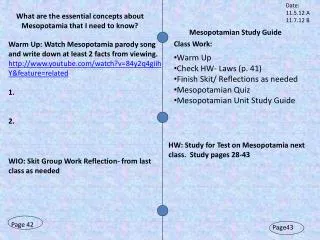
Date: 11.5.12 A 11.7.12 B What are the essential concepts about Mesopotamia that I need to know? Mesopotamian Study Guide Class Work: Warm Up: Watch Mesopotamia parody song and write down at least 2 facts from viewing. http://www.youtube.com/watch?v=84y2q4giihY&feature=related 1. 2. • Warm Up • Check HW- Laws (p. 41) • Finish Skit/ Reflections as needed • Mesopotamian Quiz • Mesopotamian Unit Study Guide HW: Study for Test on Mesopotamia next class. Study pages 28-43 • WIO: Skit Group Work Reflection- from last class as needed Page 42 Page43
Laws- HW • Pair-Share Laws • Be prepared to present at least 1 per group!!
Finish Skits/Reflections-p.40 • 1. Which of Hammurabi's laws was the most unfair? • *2. Which of Hammurabi's laws was the most reasonable? Why? • *3. What group or class of people were the most favored and protected by the code of laws? Explain. • 4. What group or class of people were least protected and least favored under the code of Hammurabi? • 5. How would you feel if you lived under the code of laws in Hammurabi's Babylon? • *6. Slavery was very common in the ancient world. Why do you think it existed? Why have most societies and cultures eliminated slavery today? • 7. Was reenacting the laws a valuable use of class time? Why or why not? • *8. Did acting out the various situations help you to understand anything better? Worse? Give examples.
Mesopotamian Life Quiz • You have 20 minutes. • You do NOT use all the words in the word bank • Flip it over when you are finished.
Grading the Quiz • Pass to another classmate to grade. • Use a different color or type of writing utensil than what is used on quiz. • Take 5 points off for each one that is incorrect. • Just put an X on ones that are wrong. • DO NOT write a score on the top of the paper
Quiz Answers-Take off 5 for each • 1. Trader • 2. donkeys or on a raft • 3. trade center • 4. Hammurabi • 5. Hammurabi’s Code • 6. Babylonian • 7. eye for an eye • 8. Gilgamesh • 9) True • 10) False
Mesopotamian Study Guide • You will work with a partner to complete the study guide. Use your notebook pages 27-42 to compete. • Make sure the study guide is taped on page 42.
Study Guide Answer Key • 1) Mesopotamia- “land between the rivers.” 1st civilization, located in current day Iraq • 2) Fertile Crescent- area of fertile land within the middle east between Mediterranean Sea and Persian Gulf • 3) Hammurabi’s Code- 1st written laws and punishments • 4) Irrigation- method to get water to crops. Use of channels and levees • 5) Job Specialization- people will focus on one job to help the society
Study Guide Answer Key con’t… • 6) Agriculture- innovation in farming crops which led to a surplus in food • 7) Ziggurat- Mesopotamian temple • 8) Cuneiform- 1st written language. Wedge-shaped writing • 9) Civilization- a group of people working and living together • 10) Social class- levels within society based on job/wealth status. Nobles/Priests/Kings> Merchants and Farmers> Slaves
Study Guide Answer Key con’t… • 11) Trade Center- central location where tradesmen will gather to trade goods • 12) Polytheistic- religion which worships many gods. Monotheistic- religion which worships one god. • 13) Innovation- a new development, could be an invention or an idea, which improves an aspect of society • 14) Cradle of Civilization- nickname for Mesopotamia because it is the beginning of civilization
Study Guide Answer Key con’t… • 15) Rivers! Early civilizations needed water and fertile land in order to survive. • 16) Lack of food, water, shelter, and natural resources or a threat from another civilization were constant problems the early civilizations faced. • 17) Cuneiform, the wheel, ramps, number systems, etc. • 18) The Epic of Gilgamesh taught the people of Sumer about various gods and how one should lead a life where good is done. • 19) Shows values and treatments based on social class and gender. Government has responsibility to control the people.
Homework • STUDY FOR YOUR TEST THURSDAY/FRIDAY • Pages 27-42 in notebook