Download
1 / 30
300 likes | 402 Views
Explore the science of earthquakes with engaging experiments like the popsicle activity and Alka-Seltzer balloon reaction. Discover how stress and geological forces shape the Earth's crust through various fault types, including transform, convergent, and divergent boundaries. Learn to assess earthquake risks and safety measures for buildings, such as base isolation and flexible materials. This guide offers a comprehensive overview of seismic waves, earthquake damage, and preparedness strategies to keep you safe in an earthquake-prone environment.

E N D
Earthquakes 5.1
Popsicle Activity • EXPERIMENT by Holding the popsicle stick on each side with both hands. • Slowly bend it into an arch. • Release pressure and OBSERVE. • Repeat steps 1 and 2, but continue to bend towards one another. ANALYZE. What do you conclude?
Alka-Seltzer in balloon activity • Place 1 Alka-Seltzer tablet in a balloon. • Pour in 1 cup vinegar. • Tie balloon and OBSERVE. Analyze your data. What do you conclude?
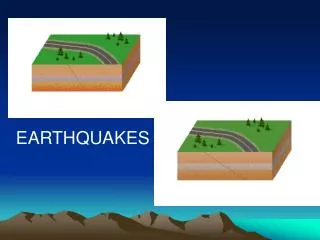
Earthquakes stress • Are formed by ______________, or a force acting on a rock to change or deform it. • A _________ along a plate boundary is a break in the Earth’s__________. Crust Mantle Core fault
Boundaries • Transform • STRESS – Shearing (like scissors) • FAULT – Strike-slip • Example – San Andreas Fault, CA
Plateau Boundaries • Convergent • STRESS – Compression • FAULT – Reverse • Example – Appalachian Mountains Hanging Wall Foot Wall
Boundaries • Divergent • STRESS – Tension • FAULT – normal • Example – Rio Grande Rift Valley Hanging Wall Foot Wall
Folds • Not a crack or break, but a bend • Anticline – Top • Syncline – Bottom • Example – Black Hills of South Dakota Draw here
Earthquakes 5.2 Measurement
Waves Primary • P Waves – • S Waves – • Surface Waves - Secondary Surface
Travels epicenter fault focus
“Rating” Machines effects • Mercalli – • Richter – • Moment Magnitude Scale – intensity energy
Data Analysis • See overhead
Recording Station and Epicenters • Gizmos • www.explorelearning.com • LAB – 5 points
Hazards and Safety 5.3 Pgs 74-77F
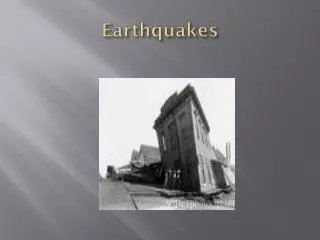
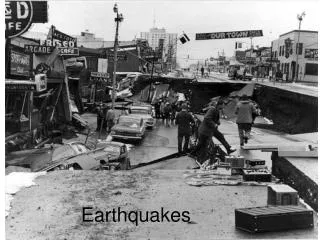
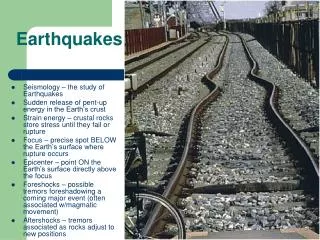
Earthquake Damage • S waves • Severe shaking damages or destroys buildings, bridges, utility poles gas and water pipes, etc • Landslides, avalanches, or tsunamis (distance wide, height short) • Fires and floods
Soil • Solid rock better than sand • Liquification – loose soil turns to mud
Safe Building • Stronger and more flexible • Location • steep slope? Fault? • Reinforce walls (see teacher example) • Anchored to ground • Base-Isolated – rests on shock absorbers “Shake not Break” • Flexible joints • Automatic shut-off valves • Fixed-Based -
In an Earthquake • Stay away from falling debris • Drop, cover, hold • Outside – open area • Earthquake kit
“Preparedness Now” http://www.shakeout.org/downloads/PreparednessNow_50mb_081107.mov
USGSCAL EMA • http://www.shakeout.org/drill/
Earthquake Proof Room • 16 points • Draw and label 4 stay safe solutions • Par. Describing • Earthquake • Dangers • Why you chose the solutions • Neat scholarly, scale
Earthquake Proof Structure • Rubric “Shake, Rattle and Roll”
Study Guide • MC wkst • Reverse crossword • Pgs 84-85F