Understanding Refracting Telescopes: Light Gathering and Magnification Fundamentals
Refracting telescopes utilize lenses to bend and focus light from distant celestial objects, making them essential for observing faint astronomical phenomena. The collection of light is more critical than mere magnification, with the aperture diameter directly influencing light gathering power. The principles of refraction and reflection play crucial roles in achieving optimal viewing conditions. This guide covers the key components, such as focal length, aperture size, and their impact on image brightness, while exploring chromatic aberration and the significance of instruments like the Yerkes Refractor.
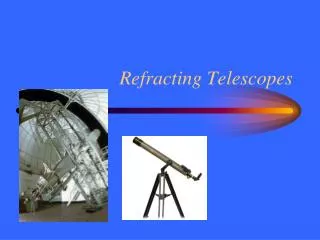

Understanding Refracting Telescopes: Light Gathering and Magnification Fundamentals
E N D
Presentation Transcript
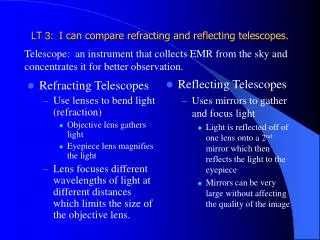
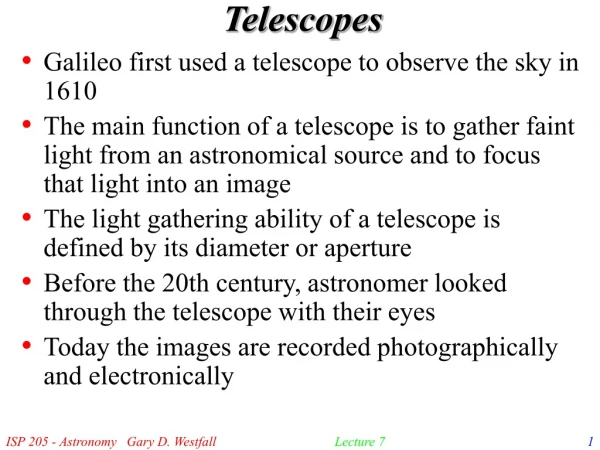
Faint Light • Astronomical objects are distant and faint. • Effectively at infinity • Light collection is more important than magnification. • Refraction • Reflection • The Andromeda Galaxy (M31) is 3° wide. • 6 times the moon • Only visible to the unaided eye in very dark conditions
Refraction • Light is bent at the surface between two media. • This bending is called refraction. • Lenses use refraction to bend and focus light. • focal length and a focal point • Parallel rays from a distant source focal point focal length
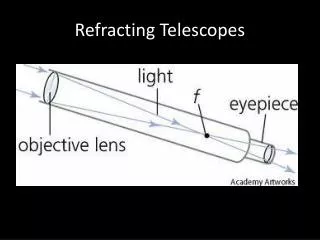
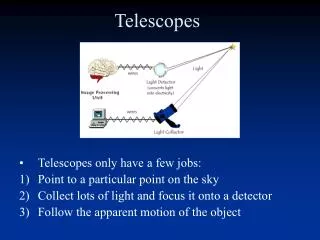
Concentrator • A refracting telescope uses lenses to concentrate light from a distant object. • Object light rays nearly parallel • Final image rays also parallel objective focal point eyepiece
Aperture • Lenses collect and concentrate light by refraction. • The diameter (D) of the objective lens is the aperture. • Measured in m or mm • Larger apertures for fainter objects • The light gathering power (LGP) is related to the area of the lens. • Circular lens: A = (D2)/4 • Relative to eye aperture 5 mm: LGP = D2/(5 mm)2
F-Stop • The brightness of an image is measured by the focal ratio of the focal length to the aperture. • F-number or f-stop = f/D • Dimensionless quantity • Denoted by f/ • Lower f-numbers are “faster” and need shorter exposure times. Primary focal length = Aperture diameter x f-number
Magnification • Refracting telescopes magnify images with two lenses. objective focal point eyepiece Primary focal length Magnification = Eyepiece focal length
Real material refract colors differently. Blue light bends more than red Compound lenses can compensate for chromatic aberration. Chromatic Aberration Tony and Marilyn Karp Wikipedia
Yerkes Refractor • World’s largest refractor is in Wisconsin. • 40 inch aperture, f/19. • 63 foot tube. Yerkes 40 inch