Download
1 / 14
140 likes | 285 Views
This resource explores effective knowledge mobilization strategies developed by Emily Gagnon and Professor Angie Hart at Boingboing Social Enterprise/University of Brighton. Central to the concept of Communities of Practice, the emphasis is on sharing, mutuality, and collaboration across organizational and disciplinary boundaries. The aim is to foster active community-university partnerships, enabling groups to accumulate knowledge, develop unique perspectives, and build personal relationships. Engage with various forms of participation to enhance collective problem-solving and learning in diverse global contexts. For further resources, visit www.cupp.org.uk.

E N D
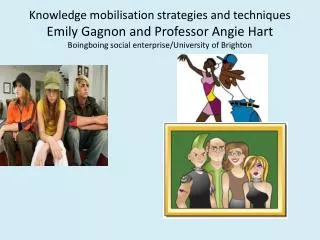
Knowledge mobilisation strategies and techniquesEmily Gagnon and Professor Angie HartBoingboing social enterprise/University of Brighton
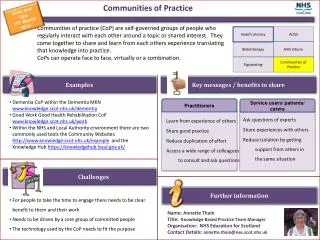
Communities of Practice “…groups of people informally bound together by shared expertise and passion for a joint enterprise” (Wenger & Snyder, 2000) • Emphasise sharing and mutuality • No fixed boundaries between the ‘experts’ and the ‘non-experts’ • Expectation that members will work across organisational and disciplinary boundaries • Challenging current structures and hierarchies
Active Community University Partnership Relationships Canada: Halifax, Toronto, Victoria England: Brighton, Hastings, London, Durham, Sheffield Scotland: Edinburgh, Stirling Sweden: Västerås, Gothenburg Germany:Osnabrück Wales: Newport Australia: Sydney Greece: Crete Malaysia: Kuching
The hope is that they: • Accumulate knowledge and become bound by the value they find in learning about the issue together • Develop a unique perspective on the issue or problem, as well as a body of common knowledge, practices and approaches (eg tools, standards, manuals, materials) • Develop personal relationships and established ways of interacting with each other www.cupp.org.uk
Forms of participation transactional lurkers outsiders peripheral occasional experts alumni active beginners core group leaders coordinator sponsors www.cupp.org.uk
A few things to read… • https://researchimpact.othree.ca/forums/journalclub/mobilisingknowledgeincommunityuniversitypartnershipswhatdoesacommuni • www.boingboing.org.uk • Just start a these two places, and you can follow up a load of links if you like reading…
Contact and follow up • Cupp network. For news and discussion, free to join but need to register: • www.cuppcop.ning.com Cupp website – details of our work and sign up for email newsletter: www.brighton.ac.uk/cupp