REPOSITIONING UCL
This report outlines UCL's strategies to address financial challenges through repositioning. After experiencing cuts and under-investment, UCL aims to move from a deficit to a balanced budget and eventual surplus. The report discusses staff cost reductions, preservation of core strengths in teaching and research, and comparisons with other universities. Progress on the Income Generation and Savings Programme (IGSP) is highlighted, detailing identified savings and strategies to enhance income. A timetable for continued discussions and actions is also included.

REPOSITIONING UCL
E N D
Presentation Transcript
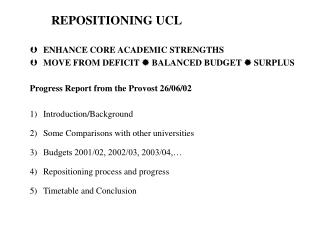
REPOSITIONING UCL ENHANCE CORE ACADEMIC STRENGTHS MOVE FROM DEFICIT BALANCED BUDGET SURPLUS Progress Report from the Provost 26/06/02 1) Introduction/Background 2) Some Comparisons with other universities 3) Budgets 2001/02, 2002/03, 2003/04,… 4) Repositioning process and progress 5) Timetable and Conclusion
INTRODUCTION/BACKGROUND Following years of cuts in funding and under-investment in maintenance, need reduction in costs and/or increase in income (by the outstanding deficit + £4.5m pa to fund maintenance properly + desired surplus for future developments) AND ability to sustain a continued increase of income(or decrease in costs) to compensate expected continued under indexation (e.g. 2% of “free” income of £175m £3.5m pa) Clear that must reduce staff costs ( £125m of “free” income) and focus on core strengths (emphasising academic coherence and links - UCL is a university - as well as income generating capacity)
UCL vs. OTHER UNIVERSITIES Many other universities face major financial difficulties, but there are some special features at UCL: Open (merit, no quotas) academic promotion policy, plus relatively high (if inadequate) professorial salaries should protect, but very high academic staff costs Largest charity income (£64.5m) of any UK university, which only pays direct costs (although it generates some QR): arguing ( CSR) for government to fill funding gap on charity and Research Council funding (+ fund RAE, SRIF 2 without matching funds,…) Particularly large maintenance backlog excellent student: staff ratio there is scope to reduce staff without damaging competitive position if it is done carefully, focusing on core teaching and key research strengths
BUDGETS • 2002/03 - assuming savings identified in 2001/02 consolidated • initial deficit of £8.7m (but with budget in which [already inadequate] maintenance was only increased 1% in cash) • - so far identified £3.2m in staff savings - more to come, and hoping for additional income 2001/02 - began facing £10.8m deficit income generation/savings programme (IGSP), target £7.0m, plus asset sales £3.8m - IGSP £6.75m, but asset sales have not materialised and meanwhile goal posts moved currently estimate £5.0m deficit • 2003/04 - facing any outstanding deficit from 2002/03 plus £3.7m shortfall currently predicted [Note: if CSR funding restored for 5 rated Depts (possible) + £5.4m, 4 rated (conceivable) + £1.6m, 3 rated (almost inconceivable) + £100k]
PROCESS & PROGRESS 2001/02 IGSP - detailed work/prioritisation by VPs with HoDs, supported by Finance Division and Deans decisions by Provost and VPs Since March 2002 - working, on basis of evidence (student: staff ratios, income/academic, income/m², student applications,...), on repositioning and in parallel (in the context of emerging repositioning strategy) on IGSP*: Identify core teaching + key research strengths plus possible structures for 2010 cost how to get there With few exceptions, not looking to close whole areas/Departments (UCL’s core strength as a genuine university with across the board strengths must be fostered) - looking for key subdisciplines/themes, with emphasis on mutual links and objective evidence of academic and financial strengths: this detailed work can be led but not done centrally Increased role of Deans (endorsed by Council March 2002) in support of VPs - essential for looking across Departmental boundaries * Also examining central services and administration
Six discussion/feedback/brainstorming meetings of Provost, VPs, Deans, • Senior UCL officers Provost + VPs for IGSP decisions • Phase 2 • Provost meeting separately/systematically Faculty by Faculty with VP + Dean • + HoDs, and in some cases whole Faculty assess/cost/decide on repositioning • Present Status: in one case outcome essentially clear and savings target met, clear pictures emerging in some others - many good proposals for more efficient delivery of excellent teaching and greater coherence in research Phase 1 - March - Mid June VPs + Deans + HoDs repositioning options intensive work on IGSP for 2002/03
TIMETABLE June - September - complete phase 2 and talk to unions on major proposals for change prior to: Finance Committee, 30 September - hope to report substantial progress on 2002/03 IGSP plus longer term financial outlook Council Strategy Meeting, 21 October - will present repositioning plans 21 October - 19 December - discussion at Planning & Resources, Academic Board, talk further to unions Council, 19 December - approval of reposition plans CONCLUSIONS IGSP - £6.75m in 2001/02 + over £3m already identified for 2002-03 is a major achievement, but not enough Repositioning - focusing on core strengths/themes is key, but difficult: needs work across the board; hard to identify/quantify savings and enhancement of income generating capacity BUT it can/must be done and will ensure UCL’s future as a great university