Download

1 / 11
110 likes | 231 Views
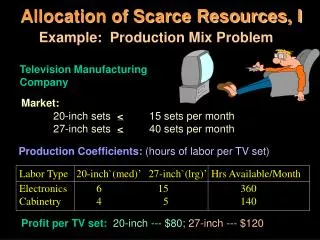
This document explores the application of linear programming in optimizing the allocation of limited resources. It includes constraints on materials, labor, and machine capacity, with specific examples illustrating these concepts. The constraints are detailed for materials (8Y + 4Z ≤ 3,440), labor (6Y + 8Z ≤ 2,880), and machine capacity (4Y + 6Z ≤ 2,760). Furthermore, it identifies feasible production combinations and solutions by solving equations to determine optimum output levels for resources Y and Z while evaluating opportunity costs.

E N D
LEARNING NOTE 11.1 The use of linear programming for the allocation of scarce resources
LN11.1 (1a) Linear programming
LN11.1 (1b) Example (cont.)
LN11.1 (2) Materials constraint (8Y + 4Z 3,440 (When Y= 0, Z = 860; when Z= 0, Y = 430
LN11.1 (3) Labour constraint 6Y + 8Z 2,880 (when Z = 0, Y = 480; when Y = 0, Z = 360)
LN11.1 (4) Machine capacity constraint 4Y + 6Z 2,760 (when Z = 0, Y = 690; when y = 0, Z = 460)
LN11.1 (5) Sales limitation Y 420
LN11.1 (6) Optimum solution Feasible production combination = Area ABCDE
LN11.1 (7a) Optimum solution 1. The optimum output can be determined by solving the simultaneous equations that intersect at point C: 8Y + 4Z = 3 440 6Y + 8Z = 2 880 so that Y = 400 and Z = 60
LN11.1 (7b) Optimum solution 2. The materials and labour constraints are binding and therefore have opportunity costs. The marginal contribution from obtaining one extra unit of materials can be calculated by solving the following equations: 8Y + 4Z = 3 441 (revised materials constraint) 6Y + 8Z = 2 880 (unchanged labour constraint) Y = 400.2 units, Z = 59.85 units Therefore the planned output of Y would be increased by 0.2 units and Z reduced by 0.15 units and contribution will increase by £0.40 (the opportunity cost).
LN11.1 (7c) Optimum solution 3. The marginal contribution from obtaining one extra labour hour can be found in a similar way: 8Y + 4Z = 3 400 (unchanged materials constraint) 6Y + 8Z = 2 881 (revised labour constraint) Y = 399.9 and Z = 60.2 Marginal contribution = £1.80