Advancements in Machine Learning, Data Mining, and Behavior Modeling: Interdisciplinary Insights
This breakout session, moderated by Narayanan C. Krishnan from WSU and Qiang Yang from Hong Kong UST, focuses on the challenges and opportunities in machine learning, data mining, and behavior modeling. Key discussions will revolve around interdisciplinary approaches, data sharing and annotation, algorithms designed for large, noisy datasets, and the importance of longitudinal data. Attendees include experts like Du Li, Diane Cook, and Mohan Trivedi, emphasizing the need for better understanding application goals, educational programs, and funding for innovative research in behavior modeling.

Advancements in Machine Learning, Data Mining, and Behavior Modeling: Interdisciplinary Insights
E N D
Presentation Transcript
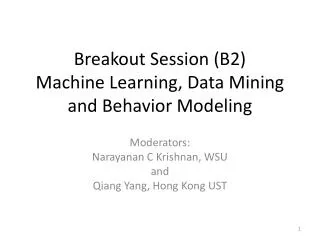
Breakout Session (B2)Machine Learning, Data Mining and Behavior Modeling Moderators: Narayanan C Krishnan, WSU and Qiang Yang, Hong Kong UST
B2 Machine learning/behavior modeling, data mining • Facilitators/Scribes: • Narayanan Krishnan (Washington State University), Qiang Yang (Hong Kong University of Science and Technology, Hong Kong) • Attendees: • Du Li, David Chu, Gustavo de Veciana, Dejing Dou, Diane Cook, FarnoushBanaei-Kashani, MircoMusolesi, Oliver Brdiczka, Wang-Chien Lee, TanzeemChoudhury, Wendy Nilsen, Michael Anderson, James Landay, James Rehg, Mohan Trivedi, SvethaVenkatesh, Andrew Campbell
Central Questions • Challenges in • Data • Algorithms • Interdisciplinary
Machine Learning and Data Mining, Behavior Modeling • Grand Challenges • Data • Share the data, annotate the data socially, where the data meet the objectives, • Longitudinal data set over time • Social media for data collection and annotation • Algorithms • Live with noise, poorly labeled but large quantities of data, but design algorithms that are distributed, adaptive, capable of online learning (can learn as the data arrives) • Benchmarking, competition • Multidisciplinary • Better understanding of the application goals and objectives • Understanding taxonomy, temporal, social properties human behavior • Education programs • Funding for Interdisciplinary research for behavior modeling