Recent Trends in Health Facility Planning and Design in Australia
This presentation by Warren Kerr, National Director of Hames Sharley, offers an overview of the current landscape of health facility planning and design in Australia. It discusses the structure and roles within the Australian healthcare system, highlighting recent projects and innovative trends in design. Key topics include procurement methods, evidence-based design, and lessons learned from ongoing healthcare infrastructure projects. With over 30 years of experience, Kerr emphasizes the critical link between planning, health outcomes, and operational efficiency in a diverse and evolving system.

Recent Trends in Health Facility Planning and Design in Australia
E N D
Presentation Transcript
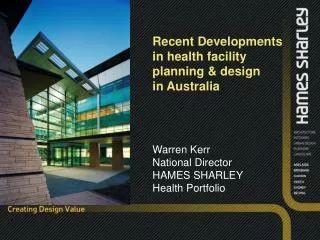
_slide title. Recent Developments in health facility planning & design in Australia • dot point • dot point Warren Kerr National Director HAMES SHARLEY Health Portfolio
Brief overview of Australia • Overview of Australian healthcare system • Roles and responsibilities in providing healthcare • Health facility planning & design in Australia • Recent Projects • Trends & design innovations • Procurement Methods • Lessons learned Outline of Presentation
My views are derived from my role as a practitioner • 30 years experience in hospital planning & design • Current project responsibilities include a number of hospital projects and leading the Hames Sharley team in JV for $2.0 billion Fiona Stanley Hospital • Try to combine work as a practitioner, researcher, teacher and advocate for improved processes • Main interest is the health outcomes and operational cost implications of planning and design decisions My Background
Population – 22.8 million • A nation of migrants – first immigrants 51,000 years • Then 1788, 1860’s 1890 & 1950’s • Original inhabitants - Australian Aborigines 2.4% • 7.7 million sq kms (3 million sq miles) • Density 2.5 persons per sq kilometre • World’s 13th largest economy • 5th highest per capital income • 3rd longest female life expectancy • 4th longest male life expectancy • Low unemployment • Became a Federation in 1901 – States retain responsibility Australia – An Overview
Health in a State’s responsibility • State Governments develop, own, operate hospitals • States responsible for acute, mental & community services • Federal (Commonwealth) Govt – Health Insurance 1975 • Free Government health system – Medicare 1984 • Federal Govt reimburses GP’s & funds pharmaceuticals • 9 separate health systems (6 States & 2 Territories) • Plus healthcare for Aborigines - but very poor outcomes • Public & private hospitals • 1,326 hospitals (753 public & 280 private & 293 day-only) • 9.4% of GPD on healthcare (up from 7.6% in 1975) Australia Healthcare System
Health facility development is a State responsibility • Young country - so most hospitals built after WWII • Public Works Departments • 1980-90’s outsourced to private sector • Traditional procurement methods thro to 2000 • 2000-05 started to use PPP’s • $7.3 billion capital works program - $84 b mining • Major PPP’s now completed • Each State & project team isolated • No research centre or formal sharing of information Health Facility Planning & Design
Recent Trends • Greater use of private sector • Greater variety of procurement methods • Sharing of information re design of health facilities • Australian Health Design Council • Australasian Health Facility Guidelines • Separation of capital cost and operational cost • Evidence Based Design • Greater integration of research and health delivery • Evaluation of outcomes Trends in Australia
Increasing range of the procurement methods used • Traditional Construction Tender • Managing Contractor • Early Contractor Involvement • Design Build • Public Private Partnerships – Constructor led • Public Private Partnerships – Health Operator led • Contractor led Design & selection of consultants • Novation of consultants • Consultant Clients – Project Directors Procurement Methods
Design Innovations • Evidence Based Design • Recognition/impact of facilities on healthcare delivery • Greater number of single rooms (but small) • Outlook to nature (landscaped podiums) • Use of Automated Guided Vehicles (AGV’s) • Link between health research and healthcare delivery • Greater integration of engineering services • Changing importance of ICT Design Innovation in Australia
Need for • Better coordination between public & private sector • Training and post graduate programs • Funding for research (% of capital funds) • Improved evaluation of outcomes • Improved coordination between projects and states • Better sharing of information • National Centre of Excellence (like CHAA) • Improved dissemination of research results Lessons Learned
Australian Healthcare Design 2000-2015 A Critical Review of the Design and Build of Healthcare Infrastructure in Australia
_slide title. QUESTIONS • dot point • dot point Warren Kerr National Director HAMES SHARLEY Health Portfolio