Understanding Gravitational Lensing with Gradient Refractive Index (GRIN) Lenses
The study of the refractive index at points within a lens exhibiting a radial gradient provides insights into gravitational lensing. As mass objects influence light, their combined effects on deflection angles demonstrate the principles of vector superposition. Key phenomena, including the Einstein Ring observed by the Hubble Telescope, help illustrate how surface density must exceed critical mass density to form multiple images. This research integrates concepts from gravitational potential, ray tracing, and time delay calculations to enhance our understanding of astronomical observations.
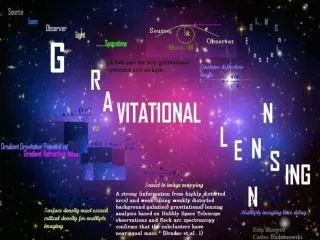

Understanding Gravitational Lensing with Gradient Refractive Index (GRIN) Lenses
E N D
Presentation Transcript
Gradient Refractive Index The refractive index of a particular point of in a lens with a radial gradient refractive index The refractive index of a particular point of a lens with a gradient refractive index The effects of gravitational potential as related to the effects of a refractive index G.R.I.N. LENS
Angle of deflection: One ray. One Mass. In reality we have multiple masses… Vector superposition! “The total deflection angle is the vector superposition of the deflections due to all the mass elements of the lens.” (Blandford et al. 825) Surface density must exceed critical mass density somewhere within the gravitational lens. For multiple images, the object must lie within the cusp.
Ray Tracing: Multiple images Caustic cusp due to the gravitational lens is shown in ray tracing using the angle of deflection for individual rays in superposition. Einstein Ring First complete ring observed Hubble Telescope (1998)
Density Perturbations, Image to source mapping, Time delay Time delay calculation is composed of the geometrical delay and the potential time delay R (Image) S (Source)
References • Blandford, R., et al. Gravitational Lens Optics. .JSTOR. Science. 245: 824-830. 1989. Web. Nov. 2010. • Bradac, M., et al. Revealing The Properties of Dark Matter in the Merging Cluster Macs J0025.4-1222. arXiv:0806.2320v2 [astro-ph]. 2008. Web. Nov. 2010. • Levine, H., A. Petters, J.Wambsganss. Singularity Theory and Gravitational Lensing. Boston: Birkhauser, 2001. • Mellier, Y., et al. Lecture Notes in Physics: Gravitational lensing. Berlin: Springer-Verlag, 1990.
Images • King, L. U. Manchester. NICMOS ,HST, NASA. 1998. http://apod.nasa.gov/apod/ap980330.html • Tsioulia, Andrew,. Gradient Index (GRIN) Lens. 2003 http://www.informaworld.com/smpp/contentncontent=a713548186~db=all~dumptype=rss • Solar Eclipses Overview. 2010. http://scie.eja.int/science_e/www/object/index.cfm?fobjectid=37889&fbodylongid=1786 • Grin Micro Lens. http://www.acphotonics.com/products/product_files/GRIN%20/Lens.htm • Optica Software. http://www.opticasoftware.com/faqs/