Mastering Spanish Subject Pronouns: Essential Guide
140 likes | 281 Views
Understand and use Spanish subject pronouns effectively. Learn the differences between English and Spanish subject pronouns, including examples and pronunciation tips. Improve your language skills now!


Mastering Spanish Subject Pronouns: Essential Guide
E N D
Presentation Transcript
A pronoun is a word that takes the place of a noun. • When the pronoun is the subject (the person doing the action) of the sentence, it is called a Subject Pronoun. Example: Bob is swimming. He is swimming. What is a pronoun? Subject Subject Pronoun
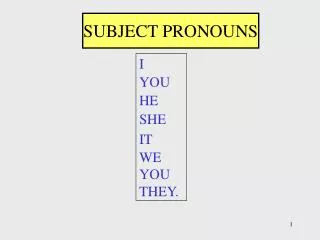
Spanish subject pronouns are similar to English, but there are some differences. English subject p
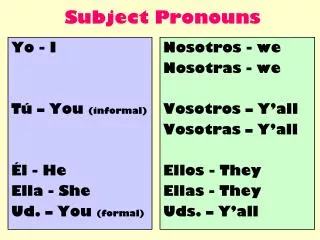
“Yo” means “I” and is used in the same way as in English. • Yo soy alumno. • Note that it is not capitalized unless it starts a sentence: • Mi amigo y yo… The first person singular pronoun “YO”
Tú means you (familiar/ informal) • Used when talking to someone familiar • We’ll learn more about this in a moment. Second person singular pronounTú
Él = he • It is used when talking ABOUT a boy/guy/man. • DON’T forget the accent mark. If you do, you are actually writing the Spanish word for “the” • él = he el = the 3rd person singular masculine él
Ella = she • It is used when talking ABOUT a girl/woman. • Please pronounce it correctly. • It sounds like (eh-yah) not (el-lah) • Remember ll= y sound. 3rd person singular FeminineElla
Use nosotros/ nosotras to talk about a group of people that includes you. • in English we have one word to talk about “we,” but in Spanish, we distinguish between “we” masculine and feminine: • Jennifer & Ana say Nosotrassomosalumnas. • Ben and John say Nosotrossomosalumnos. The first person plural pronoun “Nosotros / nosotras”
VOSOTROS means you all • Familiar (when talking to friends the • same age as you • There is also a distinction of gender • Vosotras – you all feminine • Vosotros – you all masculine 2nd person pluraVOSOTROS / AS
Ellos = They (masculine) • It is used when talking ABOUT a group of boys/guys/men or a mixed group. • Please pronounce it correctly. • It sounds like (eh-yohs) not (el-lohs) • Remember ll= y sound. 3rd person Plural masculineEllos
Ellas = They (feminine) • It is used when talking ABOUT a group of only females. • Please pronounce it correctly. • It sounds like (eh-yahs) not (el-lahs) • Remember ll= y sound. 3rd person plural FeminineEllas